When I help a factory choose a pouch packaging machine, I usually start with the product and pouch rather than the machine model. That may sound obvious, but it matters. A machine that handles dry granules well may need a very different filling system for powder, liquid, or thick paste. The same is true for the pouch itself.
Our Premade Pouch Packaging Machine, 2-Nozzle Filling-400DG is designed for this kind of practical production. It uses finished premade pouches and automatically carries out pouch feeding, opening, product filling, optional air removal or nitrogen flushing, heat sealing, coding, and finished pouch discharge.
The key feature of the 400DG is its 2-nozzle filling configuration. It gives me a useful middle ground between a single-nozzle machine and a higher-output multi-nozzle system. For suitable products, two filling nozzles can work at the same time during the filling stage, helping manufacturers improve productivity without making the machine unnecessarily complicated.
At Shanghai Huacheng Packing Machinery Company, also known as Huapack, we have focused on pouch packaging machinery since 2015. We are based in Songjiang District, Shanghai, and combine research and development, manufacturing, sales, and technical service within one operation. Our work covers food, dairy, health nutrition, medical nutrition, pharmaceuticals, personal care, agrochemicals, pet food, and other pouch packaging applications.
1. Why I Designed the 400DG Around Premade Pouches
A premade pouch machine starts with something different from a traditional form-fill-seal machine: the pouch is already made.
The customer may already have printed stand-up pouches, zipper bags, spout pouches, aluminum foil pouches, or another finished flexible package. Instead of feeding a roll of film into the machine and forming the bag during production, I feed the finished pouch directly into the packaging process.
This changes the job of the machine.
My focus becomes reliable pouch handling, accurate product filling, clean sealing, and smooth finished-pouch discharge.
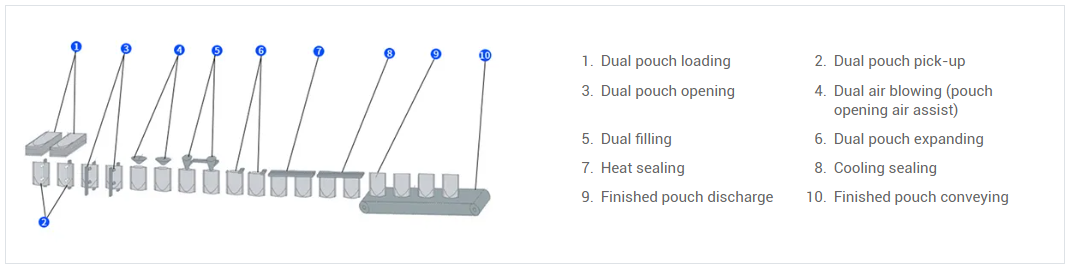
The basic production sequence is straightforward:
The operator loads finished empty pouches into the pouch magazine.
The automatic pouch feeder picks and transfers the pouch.
The pouch is positioned at the working station.
The pouch mouth is opened.
The product is filled through two filling nozzles.
Optional vacuum or nitrogen flushing can be used when required.
The pouch mouth is brought into the sealing position.
Heat and pressure are applied to create the seal.
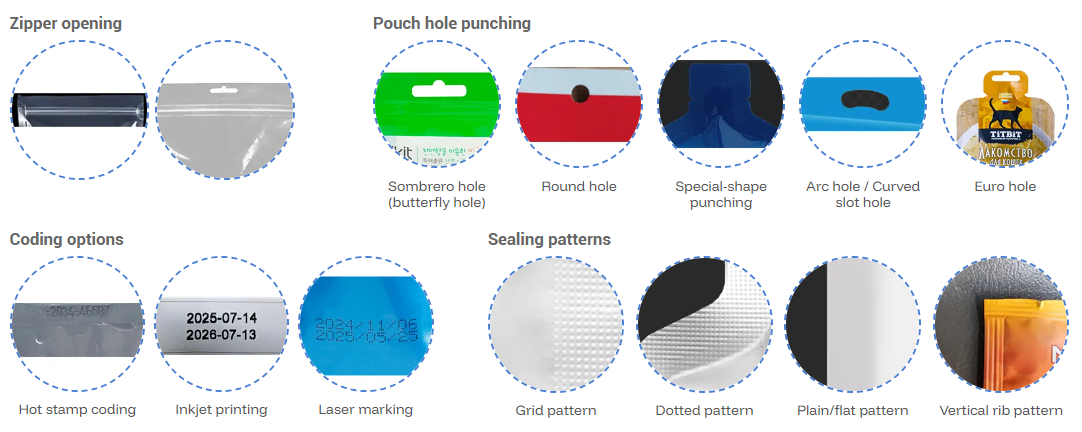
A coding system can print batch or date information when required.
The finished pouch is discharged to the next process.
It is a simple sequence, but every station needs to work at the right time.
If pouch feeding is unstable, filling becomes unstable. If the pouch is not properly opened, product can miss the pouch or reach the sealing area. If the sealing area is contaminated with product, the final seal may be affected.
That is why I look at the whole process rather than judging a machine from one specification.
| Packaging System | Packaging Material | Bag Formation | Typical Advantage |
|---|
| Premade pouch machine | Finished pouch | Completed before filling | Flexible pouch designs and printed packaging |
| Vertical form-fill-seal | Roll film | Formed during production | Continuous bag forming and filling |
| Manual premade pouch filling | Finished pouch | Already formed | Simple setup for low-volume production |
Source: Process comparison based on standard packaging-machine configurations and PMMI packaging machinery industry research. PMMI's 2025 industry report discusses flexible packaging machinery, automation, servo-driven equipment, and automated changeovers as important areas of development. PMMI, State of the Industry 2025.
For a brand that already purchases printed finished pouches, this approach can be especially useful. The package design is already complete, while the machine handles the repetitive production work.
2. How the Two-Nozzle Filling System Works
The filling system is where I pay close attention to the product.
Two nozzles are useful because the machine can fill two pouches during the filling stage when the product, pouch, and dosing system are suitable. This can improve filling productivity compared with a single-nozzle configuration.
But I would never tell a customer that two nozzles automatically mean exactly twice the production output. Real output depends on the complete machine cycle, filling weight, product flow, pouch dimensions, dosing method, and other machine movements.
Automatic pouch feeding
The process starts with the pouch magazine.
The operator loads the finished empty pouches, and the automatic pouch feeder separates and transfers them into the machine. This reduces the need for an operator to manually pick and position every pouch.
Flexible pouches can be tricky. If two pouches stick together, if the pouch is too soft, or if the surface friction is different from the tested material, feeding performance can change.
For this reason, I prefer to test the actual pouch rather than assume every pouch of the same size will behave the same way.
Pouch opening
After feeding, the pouch needs to be opened correctly.
This creates a clear path for the product and gives the filling nozzle a stable target. If the pouch mouth is not fully open, the product can hit the pouch surface, spill, or contaminate the sealing area.
For powders, dust can become a concern. For liquids, the nozzle needs to stay controlled during filling. For pastes, nozzle cut-off is important. For granules, particle size and flow can affect filling behavior.
Two-nozzle filling
Once the pouch is ready, the two filling nozzles enter the filling process.
The actual dosing technology depends on the product. For granules, I may use weighing or volumetric dosing. For powder, an auger system may be more appropriate. For liquids and pastes, pump-based filling is usually considered.
So I ask the same basic questions before finalizing the configuration:
What product are we filling?
What is the target filling weight?
How does the product flow?
Is it dusty, sticky, oily, or foamy?
Does it contain particles?
What is the required production capacity?
What pouch material and size are being used?
These questions may seem simple, but they prevent many avoidable problems later.
Heat sealing
After filling, the pouch moves to the sealing station.
The sealing system uses controlled heat and pressure to close the pouch. I look at temperature, pressure, dwell time, pouch film structure, and the cleanliness of the sealing area.
For example, if a thick sauce reaches the pouch mouth during filling, increasing the sealing temperature will not magically solve the problem. The filling and nozzle process may need adjustment first.
Good pouch packaging is a chain. Each link needs to work.
3. Main Features I Focus on in Real Production
Two-nozzle filling configuration
The 400DG is designed around a two-nozzle filling system. For suitable products and pouch formats, two pouches can be filled during the filling stage, giving the machine a practical productivity advantage over a single-nozzle arrangement.
This configuration can be a good choice for factories that need more output but do not necessarily require a four-nozzle system.
PLC touchscreen control
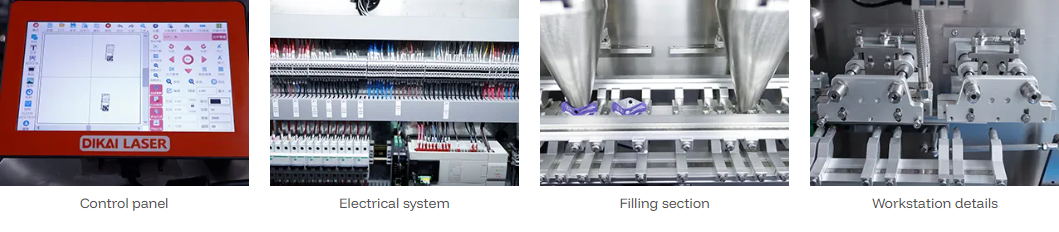
The machine uses a PLC control system with a touchscreen interface. I want the operator to be able to see machine status, adjust production parameters, and respond to alarms from one central interface.
In a real factory, simple controls matter. Operators may change between products, pouch sizes, or filling weights. The HMI should help them understand what the machine is doing rather than make the process harder.
Servo-controlled movement
The machine uses multiple servo mechanisms to coordinate important movements.
Pouch packaging is a timing job. The pouch must reach the correct position before opening. The pouch must be ready before filling. Filling must finish before sealing. The finished pouch must leave before the next cycle interferes with it.
Controlled servo movement helps us coordinate these repeated actions.
Flexible premade pouch formats
Depending on the final configuration and pouch test, the machine can work with suitable:
I always recommend confirming the actual pouch before the final machine specification. Width and height alone are not enough. Film thickness, stiffness, friction, zipper location, pouch opening, and manufacturing tolerance can all affect performance.
Optional vacuum and nitrogen flushing
Some products require more than filling and sealing.
We can configure vacuum or nitrogen flushing for suitable applications. The right choice depends on the product, pouch, headspace, storage requirements, and final packaging objective.
I do not treat nitrogen flushing as a universal shelf-life solution. The complete package needs to be tested.
Coding and downstream integration
Date coding, batch coding, conveyors, checkweighing, inspection, and downstream packing equipment can also be integrated when required.
That makes the 400DG useful not only as a standalone machine but also as part of a larger automated pouch packaging line.
| Feature | What I Check | Practical Value |
|---|
| 2-nozzle filling | Product flow and dosing method | Supports higher filling productivity for suitable applications |
| Automatic pouch feeder | Pouch thickness, stiffness and friction | Reduces manual pouch handling |
| PLC + touchscreen | Settings, alarms and machine status | Simplifies daily operation |
| Servo mechanisms | Position and cycle timing | Controlled machine movement |
| Heat sealing | Temperature, pressure and dwell time | Supports repeatable pouch closure |
| Optional functions | Vacuum, nitrogen, coding and inspection needs | Allows the machine to fit different production lines |
Source: Feature assessment based on the 400DG product configuration supplied for this page and general packaging-machine engineering practice. PMMI's industry research also identifies servo-driven systems, automation, flexible machinery, and automated changeovers as significant packaging equipment considerations. PMMI, State of the Industry 2025.
4. Matching the Filling System to the Product
When a customer tells me, “I need a two-nozzle pouch filling machine,” I still need to know what is going into the pouch.
The product decides the dosing technology.
| Product Type | Examples | What Can Cause Trouble | Possible Filling Method |
|---|
| Granules | Nuts, seeds, seasoning | Particle size, density, flow | Weighing or volumetric dosing |
| Powders | Nutrition powder, herbal powder | Dust, bridging, poor flow | Auger or suitable powder dosing |
| Liquids | Sauce, oil, cleanser | Viscosity, foam, dripping | Pump filling |
| Pastes | Cream, gel, thick sauce | High viscosity, stringing | Suitable pump or piston system |
| Small pieces | Fasteners, clips, selected snacks | Piece size and individual weight | Counting or weighing |
Source: Product examples and filling methods are application references rather than guaranteed configurations. Final dosing selection should be confirmed using actual product samples and required filling specifications.
For example, a bag of nuts may look easy to fill, but different nuts have different sizes and shapes. A fine powder may have excellent flow one day and poor flow after humidity changes. A thick sauce can behave differently depending on temperature.
These details matter when I choose the filling equipment.
For food applications, I also separate the machine from the food-contact packaging material. The U.S. Food and Drug Administration explains that food-contact substances are evaluated according to their intended use and that conditions of use include factors such as food type, temperature, and storage conditions. FDA: Food Types & Conditions of Use.
So I do not make a broad claim that a pouch machine is automatically suitable for every regulated food or pharmaceutical application. The final product, pouch, contact materials, process, and destination-market requirements need to be checked individually.
5. Where I Use the 400DG
Food and snack packaging
Food is one of the most common areas for premade pouch packaging.
I can configure suitable systems for nuts, seasoning, snacks, sauces, dried foods, seeds, and other products that fit the selected pouch and dosing system.
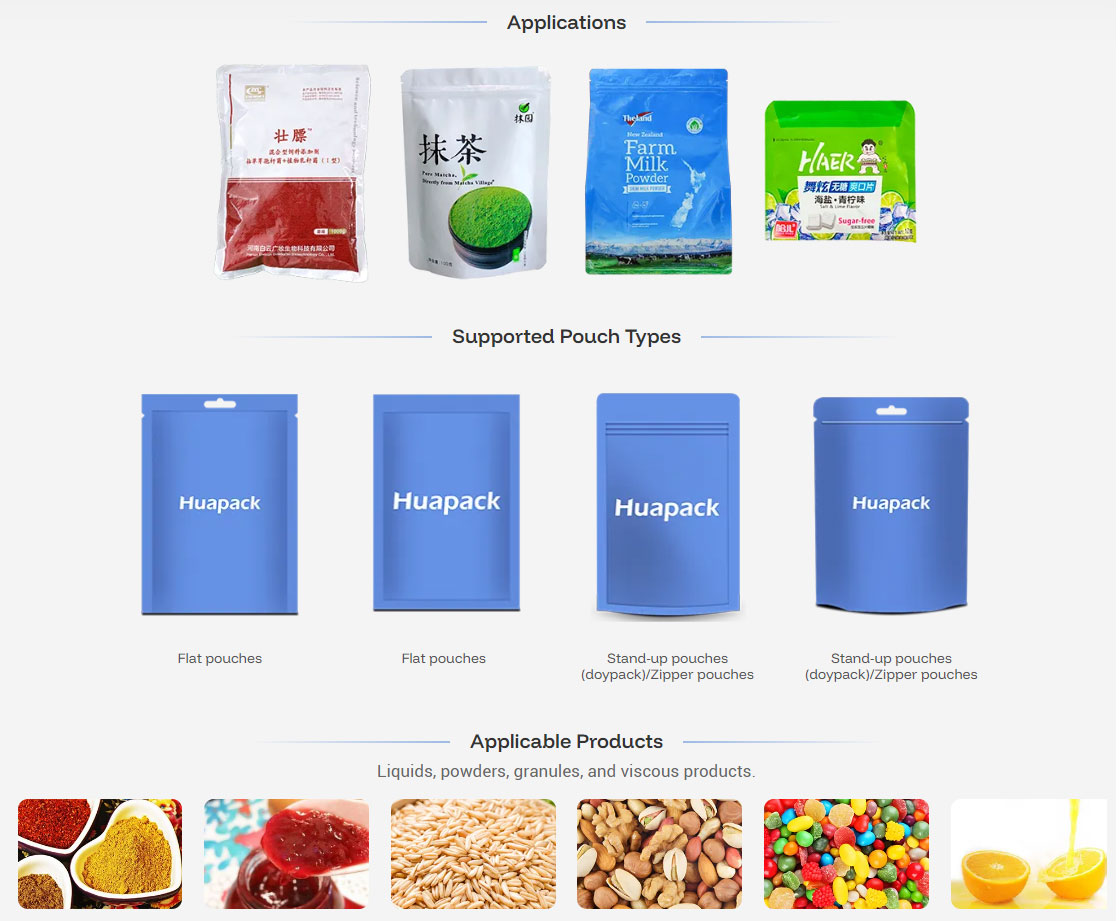
Stand-up pouches can provide good shelf presentation. Zipper pouches can be useful when the consumer wants to open and close the package. Aluminum foil pouches can be selected for applications that require particular barrier properties.
Dairy and health nutrition
Nutrition powders, selected dairy products, dietary products, and health-food ingredients can be packed into suitable premade pouches.
For powders, I pay special attention to flowability and dust. If the powder bridges in the hopper, increasing machine speed will not solve the basic problem.
Pharmaceutical and medical nutrition
Selected herbal granules, medical nutrition products, dietary powders, and other suitable products can use premade pouch packaging.
For pharmaceutical projects, I recommend discussing cleanability, hygiene, machine-contact materials, production environment, validation, and local regulations before the final configuration is approved.
Personal care and cosmetics
Liquid cleansers, shampoo, conditioner, creams, gels, and other personal-care products can be packaged into suitable pouches.
Here I pay close attention to viscosity and nozzle behavior. If the nozzle keeps dripping after filling, the sealing area may become contaminated.
Pet food
Pet treats, selected dry foods, powders, and semi-moist products can be packed using suitable premade pouch formats.
Large irregular treats may need different feeding and dosing arrangements from small uniform granules, so I always check the real product.
Seeds, agricultural products, and small hardware
Seeds, selected agricultural products, screws, clips, fittings, and other small components can also be packaged in premade pouches.
For small hardware, counting may be more practical than weighing in some cases. The machine can be configured around the chosen product and pouch format.
6. How I Build and Test the 400DG at Huapack
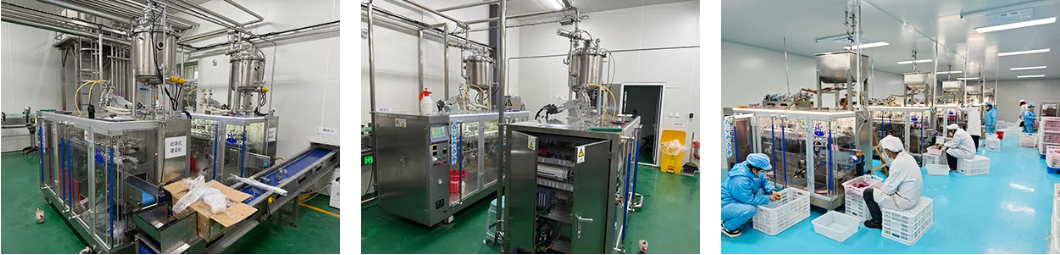
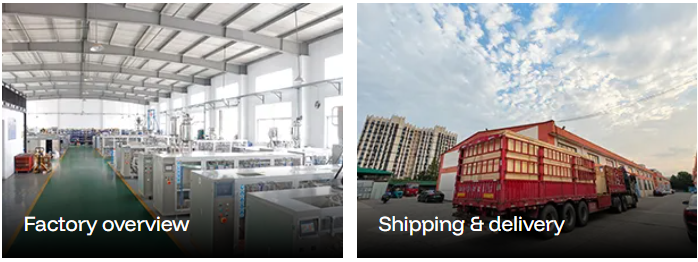
We established Shanghai Huacheng Packing Machinery Company in 2015. Since then, our operation has developed around pouch packaging equipment, with R&D, manufacturing, sales, and technical service working together.
When I start a new project, I want to know the real production conditions.
I look at:
Product type and physical characteristics
Target filling weight
Required production output
Pouch dimensions
Pouch material and structure
Pouch closure type
Required vacuum or nitrogen functions
Coding requirements
Factory layout
Future SKU and capacity plans
After that, we can select the filling system and supporting equipment.
During machine assembly and commissioning, I want to test the complete process rather than only make the machine run empty.
We check pouch feeding, pouch opening, positioning, two-nozzle filling, sealing, discharge, PLC control, servo movement, and optional equipment.
If the customer can provide real product and pouch samples, the test becomes much more useful.
For example, we may find that a pouch feeds perfectly when empty but becomes difficult to open because of its stiffness. Or a liquid may fill accurately but leave droplets around the nozzle. Or a powder may flow well at the beginning but bridge after several minutes.
These are production problems, not brochure problems.
That is why I prefer actual testing whenever possible.
PMMI's 2025 workforce research also discusses the need for better machine interfaces, operator training, OEM support, and automation as packaging manufacturers deal with workforce challenges. PMMI: Inside the Workforce Gap.
For me, this reinforces the importance of making the machine practical to operate. A machine can have advanced technology, but if the operator cannot understand it, the technology is not helping enough.
7. Why I Offer More Than a Standalone Pouch Machine
Some customers need only the 400DG. Others need a complete pouch packaging line.
Huapack can work on both.
A complete system can include product feeding, weighing, pouch filling, sealing, nitrogen flushing, coding, conveying, inspection, checkweighing, cartoning, and other downstream equipment.
I normally recommend designing these systems around the actual production flow.
For example, if the product first needs to be weighed before it reaches the pouch machine, the weighing equipment needs to match the two-nozzle filling cycle. If the finished pouch goes directly into a carton, the discharge height and orientation matter. If a Checkweigher is required, the conveyor speed and pouch spacing need to be considered.
These details are easy to overlook when each machine is purchased separately.
That is why we provide complete line integration when the project requires it.
I also ask about future production plans. If a customer expects to add several SKUs, different pouch sizes, or downstream automation later, it is better to consider those requirements during the first design stage.
The goal is not to build the biggest possible line. The goal is to build a line that fits today's production and has a sensible path for tomorrow.
8. FAQ About the Premade Pouch Packaging Machine, 2-Nozzle Filling-400DG
What is the Premade Pouch Packaging Machine, 2-Nozzle Filling-400DG?
It is an Automatic Premade Pouch Packaging Machine that feeds finished pouches, opens them, fills the product through a two-nozzle filling system, seals the pouch, and discharges the finished package.
Why does the machine use two filling nozzles?
Two nozzles allow the machine to fill two pouches during the filling stage when the product and machine configuration are suitable. This can increase filling productivity compared with a single-nozzle system.
Does two-nozzle filling mean twice the production output?
Not necessarily. Actual output depends on the complete machine cycle, filling weight, product flow, pouch size, dosing method, and other movements. I recommend confirming output through a real production test.
What types of pouches can the 400DG handle?
Depending on the configuration and actual pouch test, the machine can be adapted for stand-up pouches, zipper pouches, spout pouches, aluminum foil flat pouches, and other suitable premade pouch formats.
Can it fill granules?
Yes. Suitable granular products such as nuts, seeds, seasonings, and selected snacks can be considered. The filling method depends on product density, particle size, flow behavior, target weight, and required output.
Can it fill powders?
Yes. A suitable powder dosing system can be integrated. Powder flowability, dust, density, particle size, and filling weight should be checked before selecting the final system.
Can it fill liquid and paste products?
Yes. Suitable liquids, creams, gels, and sauces can be filled using an appropriate pump and nozzle configuration. Viscosity, temperature, foam, particles, and nozzle cut-off behavior should be evaluated.
Can I add nitrogen flushing?
Yes. Nitrogen flushing can be configured for suitable applications. The actual gas process should be tested with the product and pouch because headspace and sealing conditions affect the final result.
Can vacuum packaging be added?
Yes. A vacuum function can be included for suitable products and pouch structures. The required vacuum process should be confirmed during testing.
Can the machine print production information?
Yes. A coding system can be integrated for production dates, expiry information, batch numbers, or other required codes, depending on the selected coding equipment.
Is the 400DG suitable for multiple SKUs?
Yes. Premade pouch packaging is well suited to flexible production. Different pouch dimensions, filling weights, and products may require machine adjustments, so I recommend testing the complete SKU range before finalizing the changeover procedure.
What information do I need to send for a quotation?
Please provide the product name, product characteristics, filling weight, target output, pouch type, pouch dimensions, pouch material, and required functions.
If possible, send us actual product samples and empty pouches. These samples allow us to evaluate the pouch feeding, opening, filling, sealing, and two-nozzle configuration much more accurately.
Can Huapack provide a complete automatic pouch packaging line?
Yes. We can provide standalone premade pouch machines as well as complete pouch packaging solutions. Depending on the project, we can integrate weighing, feeding, filling, sealing, coding, inspection, conveying, and downstream packaging equipment.
Choose the 400DG Based on Your Actual Production
I designed the Premade Pouch Packaging Machine, 2-Nozzle Filling-400DG for manufacturers who want a practical step toward automated premade pouch packaging without moving immediately to a much larger multi-nozzle system.
Its two-nozzle filling configuration, automatic pouch feeding, PLC touchscreen control, servo-driven mechanisms, flexible pouch compatibility, heat sealing, and optional vacuum, nitrogen, and coding functions make it suitable for a wide range of pouch packaging projects.
But the machine should always be selected according to the real product.
A free-flowing seasoning, fine nutritional powder, thick cosmetic cream, liquid sauce, and small hardware component can all be packed in pouches, but they do not require the same filling solution.
That is why I prefer to discuss the product first.
Send me your product details, filling weight, pouch dimensions, pouch material, target capacity, and required functions. If you can also provide empty pouches and product samples, I can use them to evaluate the complete filling and sealing process and develop the 400DG configuration around your actual production needs.
Whether you are searching for a 2-nozzle premade pouch packaging machine, automatic premade pouch filling machine, premade pouch filling and sealing machine, or a complete automatic pouch packaging line, Huapack can support the project from pouch handling to final sealing and line integration.
Source note: Industry information cited in this page is based primarily on PMMI packaging machinery research, including its 2025 State of the Industry report and workforce research. PMMI reported U.S. packaging machinery sales of $11.3 billion in 2024 and discussed automation, servo-driven systems, flexible equipment, automated changeovers, workforce development, and technical support as important industry topics. FDA sources are used only for general food-contact regulatory context. Actual machine performance, pouch compatibility, filling accuracy, food-contact suitability, and regulatory compliance must be confirmed for the specific product, pouch, production process, and destination market.

 Español
 Portugues
 Pусский
 Français
 Deutsch
 日本語
日本語 한국어
한국어 العربية
 Italiano
 Nederlands
 Ελληνικά
 Svenska
 Polski
 ไทย
ไทย Türk dili
 हिन्दी
 Indonesia
 Melayu
 Tiếng Việt
 中文
中文 dansk
dansk Magyar
 қазақ
қазақ বাংলা
বাংলা עִברִית
 čeština
 Soomaali
 မြန်မာ
 فارسی
فارسی українська
 norsk
norsk Gaeilge
 беларускі
 Română
 ພາສາລາວ
 Filipino
 lietuvių
 Cymraeg
 македонски
 Suomalainen
 slovenský
 o'zbek
 اردو
اردو հայերեն
 Igbo
Igbo български
 سنڌي
سنڌي Shona
Shona සිංහල
සිංහල Hrvatski
 íslenskur
 galego
 català
 Zulu South Africa
 Afrikaans isiXhosa
 ಕನ್ನಡ
ಕನ್ನಡ lëtzebuergesch
 Indonésia Sunda
 Кыргызча
 тоҷикӣ
 Србија
 Twi
Twi Hawaii
 Cebu
Cebu नेपाल
नेपाल euskara
 frissi
 יידיש
יידיש latvija
 slovenija
 kiswahili
 ਪੰਜਾਬ
ਪੰਜਾਬ پښتو
پښتو საქართველოს
 hua moni
 bosna
bosna Kreyòl ayisyen
 Eesti
Eesti Gàidhlig na h-Alba
 Samoa
Samoa Монгол
 Azərbaycan
 አማራ
አማራ Shqipëria
 Malagasy
 Malta
Malta ខ្មែរ
ខ្មែរ Chicheva
 中文(繁体)
 ଓଡିଆ
ଓଡିଆ Setswana
 Afrikaans
 Aymara
 Башҡорт
 Türkmenler
 ትግሪኛ
ትግሪኛ Afaan Oromoo
 অসমীয়া
 Kinyarwanda
 Ilocano
 Wolof
Wolof अवधी
अवधी Oluganda
 Bikol
Bikol Fulɓe
Fulɓe Kikongo
 Sango
Sango ދިވެހި
 Lingala
 मैथिली
 Tsonga
 ꯃꯦꯏ ꯊꯥꯏ꯫
 brezhoneg
 Furlan
 नेवा
नेवा རྫོང་ཁ
 Santali
 Аҧсуа
Аҧсуа Нохчийн
 Чӑваш
Чӑваш Татар
Татар Batak Karo
 دری
دری Diura
Diura Fengyu
 Eʋegbe
 Iban
Iban Fiji
Fiji Tonga
Tonga Inuktitut
 Nahuatl
 maaya yucatec
 Runasimi
 guarani
 Qafar
Qafar Acholi
 Dinka
Dinka Luo
Luo Lundi
Lundi isiNdebele
 Tshivenḓa
 Sesotho sa Leboa
 Sesotho sa Borwa
 Ndumbe
 Papuan Pidgin
 Rromani ćhib
 Thok Nath





 WhatsApp
 Phone
Phone E-mail