When I discuss a premade pouch packaging machine with a customer, I usually start with one simple question: What are you actually packing? The answer tells me much more than the required machine name. A dry snack, a fine powder, a thick sauce, and a liquid may all use a pouch, but they do not behave the same way inside a packaging machine.
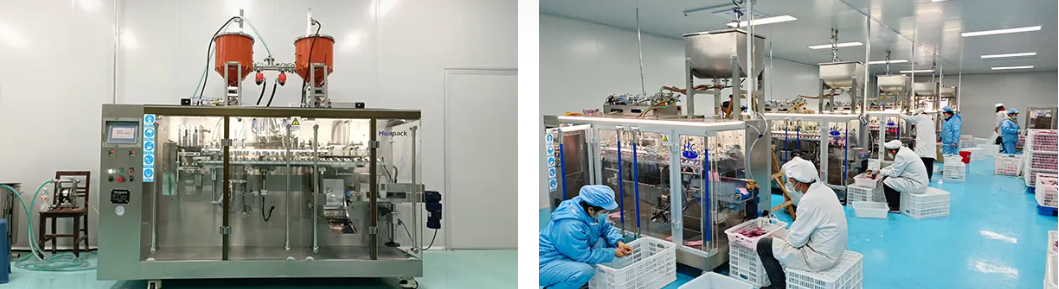
Our Premade Pouch Packaging Machine, 2-Nozzle Filling-210DG is designed for manufacturers who want to automate the handling, filling, sealing, and discharge of finished premade pouches. Instead of starting with a roll of film and making the pouch during the packaging process, this machine takes a pouch that has already been printed and formed.
At Shanghai Huacheng Packing Machinery Company, also known as Huapack, we have focused on pouch packaging machinery since 2015. From our operation in Songjiang District, Shanghai, we bring together research and development, manufacturing, sales, and technical service. Our work covers automatic weighing, pouch filling, sealing, and complete packaging line integration.
I designed the way I look at this machine around real factory needs. The goal is not simply to make the machine run. The goal is to make the complete packaging process easier to operate, more stable, and flexible enough for different products and SKUs.
The 210DG uses a two-nozzle filling configuration. For suitable products, this arrangement allows two pouches to be filled during the filling stage. The machine can also be configured with functions such as vacuum, nitrogen flushing, and coding according to the application.
For food, nutrition products, personal care products, pet food, agrochemical products, and selected pharmaceutical applications, this type of automatic premade pouch filling machine can replace a large amount of repetitive manual work while keeping the printed pouch design intact.
1. What the Premade Pouch Packaging Machine Actually Does
I often explain a premade pouch machine by comparing it with a form-fill-seal machine.
A form-fill-seal system starts with roll film. It forms the pouch, fills the product, and seals the package during the same process. Our premade pouch packaging machine starts one step later. The pouch has already been produced and printed.
This is useful when packaging appearance is important or when a brand has many pouch designs.
For example, a snack manufacturer may use one pouch for roasted peanuts, another for mixed nuts, and another for dried fruit. Instead of changing the printed film roll and forming conditions for every product, the finished pouches can be prepared separately and supplied to the packaging machine.
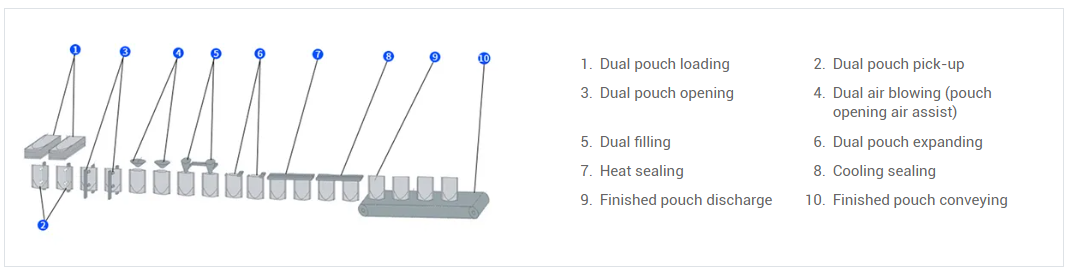
The basic working sequence is straightforward:
Finished premade pouches are placed in the pouch magazine.
The automatic pouch feeder picks and transfers the pouches.
The machine positions each pouch at the working station.
The pouch is opened.
The product is filled through the two filling nozzles.
Vacuum or nitrogen flushing can be performed when required.
The pouch moves to the sealing station.
The pouch mouth is heat sealed.
Optional coding can mark production information.
The finished pouch is discharged to the next process.
That sounds simple, but every step needs to happen at the right time.
If the pouch is not separated properly, the next station cannot work correctly. If the pouch opening is too small, the filling nozzle may not enter smoothly. If product gets into the sealing area, the seal can be affected. If the sealing temperature or pressure is not suitable for the pouch material, the final package may not have the expected seal quality.
That is why I do not treat pouch packaging as one single action. I look at the complete chain from pouch feeding to final discharge.
| Packaging Method | Main Input | Pouch Made During Packaging? | Best-Suited Production Characteristic |
|---|
| Premade pouch packaging | Finished pouch | No | Flexible pouch designs and multiple SKUs |
| Form-fill-seal | Roll film | Yes | Integrated pouch forming and filling |
| Manual premade pouch filling | Finished pouch | No | Small-scale or low-frequency production |
Source: Huapack engineering comparison based on the supplied 210DG product configuration and standard packaging-machine process structures. Actual suitability depends on the product, pouch construction, and required production conditions.
2. How I Set Up the 2-Nozzle Filling-210DG
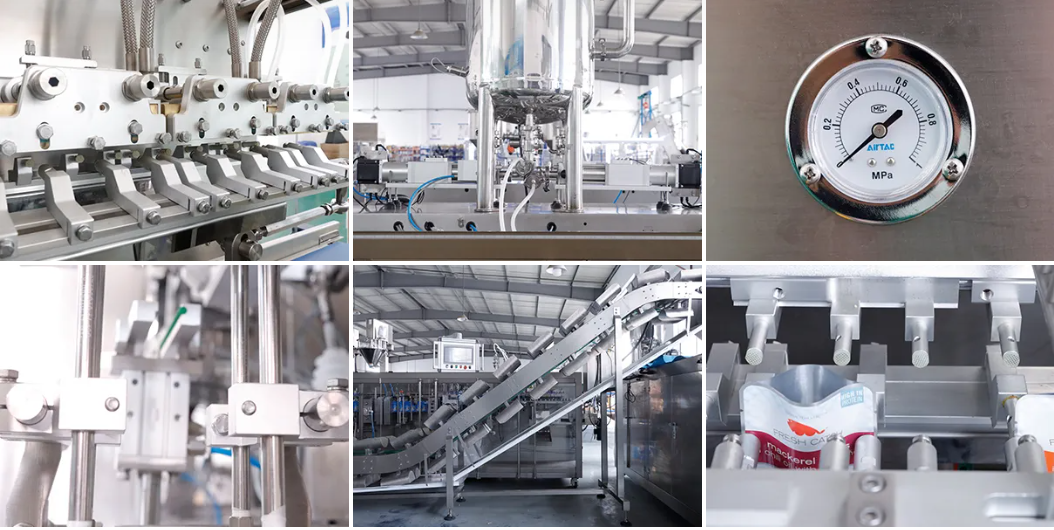
The machine is organized around several working stations. Each station has a clear task, while the PLC control system coordinates the complete cycle.
Automatic pouch feeding
The process begins with finished pouches stored in the pouch magazine.
The automatic pouch feeder separates the pouches and transfers them into the machine. This is one of the areas where the actual pouch matters a lot.
A very thin pouch may behave differently from a stiff aluminum foil pouch. A zipper pouch can have a different upper structure from a simple flat pouch. Some printed surfaces also have different friction characteristics.
For this reason, I always prefer to test the customer's actual pouch before confirming the final feeding arrangement.
Accurate pouch positioning
After feeding, the pouch needs to reach the correct position before opening and filling.
The machine uses controlled mechanical movement to coordinate pouch transfer between stations. Servo mechanisms can be used where accurate position and timing are required.
This matters because even a small positioning error can affect the relationship between the pouch mouth and filling nozzle.
Pouch opening
Once positioned, the pouch is opened for filling.
The machine needs to grip the pouch without damaging it while creating enough opening space for the filling system. Pouch stiffness, width, material structure, zipper design, and shape can all affect this operation.
For a new pouch design, I do not recommend assuming that one setting will work for every pouch. Testing gives us a much more reliable starting point.
Two-nozzle filling
The defining feature of the 210DG is its two-nozzle filling configuration.
For suitable products, two filling nozzles can work within the same filling stage, increasing filling productivity compared with a single-nozzle arrangement.
However, I want to make one point clear: two nozzles do not automatically mean twice the complete machine output.
The total cycle also includes pouch feeding, opening, transfer, filling, sealing, and discharge. If the product needs a longer filling time or the pouch needs a longer sealing time, these steps can become the limiting factor.
This is why we determine actual capacity from the complete production cycle rather than simply multiplying the number of filling nozzles.
Optional vacuum and nitrogen functions
Some products require controlled conditions inside the pouch.
For appropriate applications, vacuum or nitrogen flushing can be added to the packaging process. These functions should be selected based on the product, packaging material, storage requirements, and customer's process target.
I do not recommend adding every optional function to every machine. Extra equipment only makes sense when it solves a real production problem.
Heat sealing and discharge
After filling, the pouch moves to the heat-sealing station. Heat, pressure, and sealing time must be matched to the pouch structure.
The pouch mouth also needs to remain clean. If product enters the sealing area, even a good sealing system may not produce the result the customer expects.
Once the seal is completed, the finished pouch is discharged for inspection, conveying, carton packing, or another downstream process.
3. Main Features I Consider Important on the 210DG
Two-nozzle filling configuration
The two-nozzle design is useful for customers who need more filling productivity but want to keep the packaging system relatively compact.
It can be particularly attractive for manufacturers moving from manual or semi-automatic filling to automatic pouch packaging.
PLC touchscreen control
We use a PLC-based touchscreen control system so operators can manage the main machine functions from a central interface.
I prefer a control system that is easy to understand. In a real factory, operators should not have to spend half their shift searching through complicated settings.
The touchscreen can also make parameter management more convenient when several products or pouch specifications are handled on the same machine.
Servo-controlled machine movement
The pouch must stop at the correct position, open at the correct time, receive the filling nozzle, and then move to the sealing station.
Servo-driven mechanisms help us control these movements accurately and repeatably.
For a flexible pouch packaging machine, controlled movement is especially important because pouches do not behave like rigid bottles or cans.
Compatibility with different pouch styles
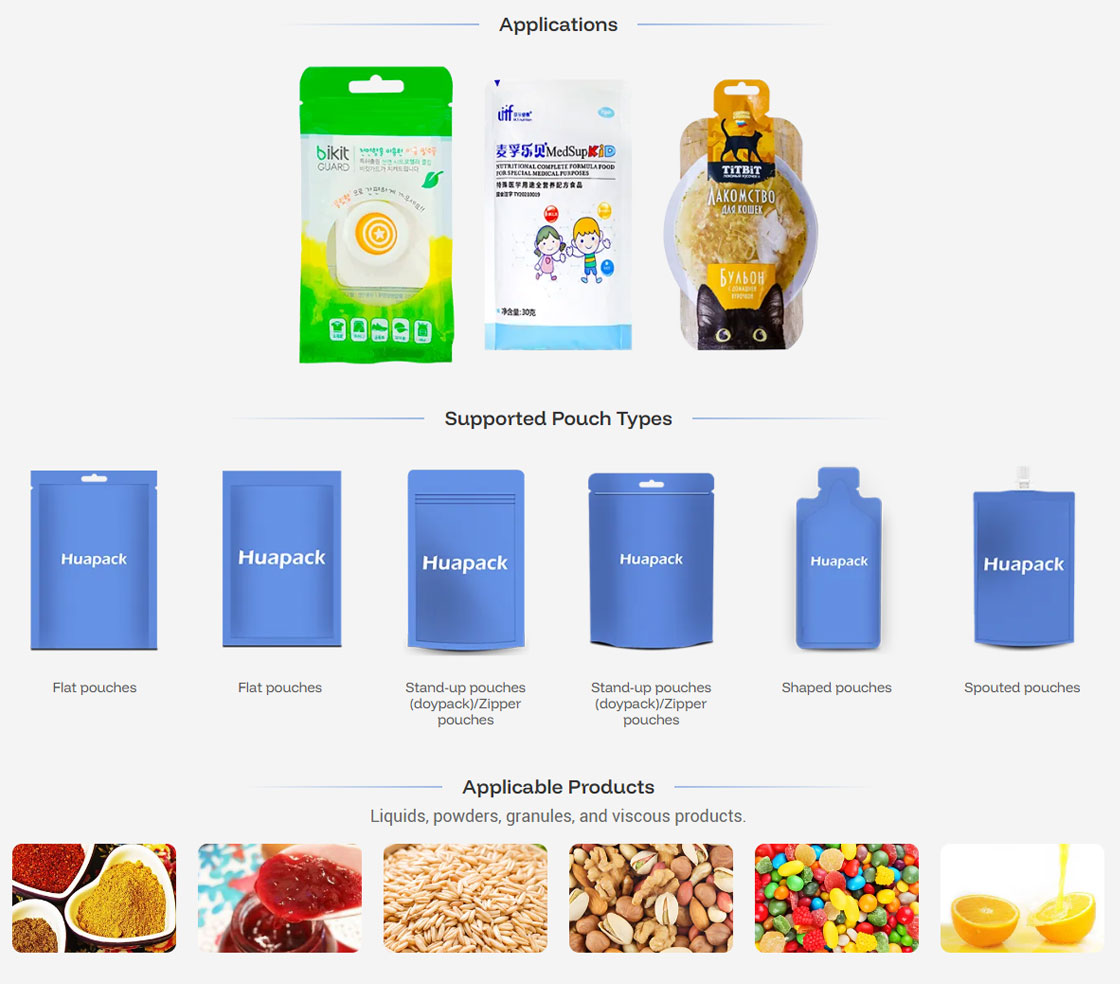
Depending on the final machine configuration and testing, the machine can be adapted for suitable pouch formats such as:
I always use the phrase “suitable pouch formats” because real compatibility depends on the pouch dimensions, material, stiffness, opening structure, and sealing design.
Flexible multi-SKU production
Modern brands often need more than one package.
They may sell the same product in several weights, flavors, or package designs. A premade pouch machine can be a practical option for this kind of flexible production because the printed pouch is prepared before entering the packaging line.
Changeover still depends on the pouch and product. However, the machine can be designed around the customer's SKU range instead of being locked to one package specification.
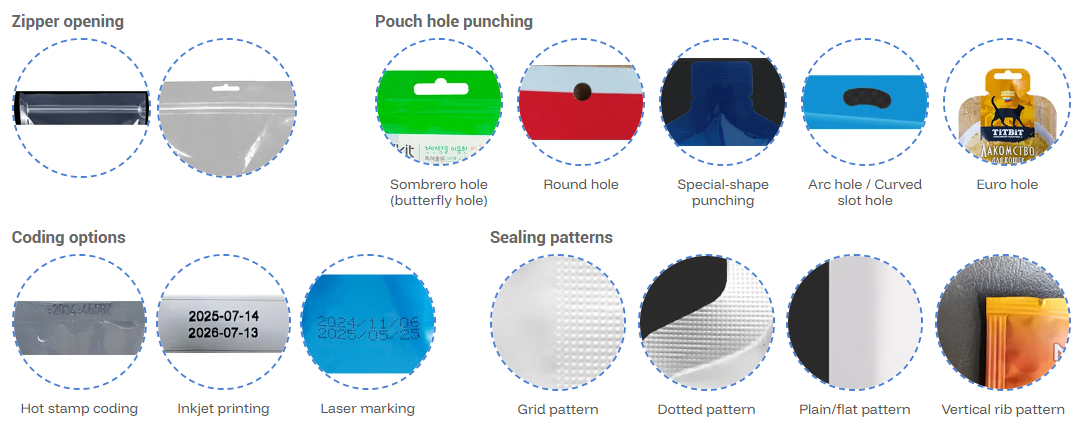
Optional coding
When required, coding equipment can be integrated to mark batch numbers, dates, expiry information, or other production data.
The final coding method should be selected according to the pouch surface, ink adhesion, required print information, and production conditions.
| Feature | What We Check | Why It Matters |
|---|
| Two filling nozzles | Product flow and filling target | Supports higher filling productivity for suitable products |
| Automatic pouch feeder | Pouch thickness, friction and stiffness | Reduces repetitive manual pouch handling |
| PLC touchscreen | Control and recipe requirements | Simplifies daily machine operation |
| Servo mechanisms | Position and cycle timing | Improves controlled movement between stations |
| Heat sealing | Pouch film and sealing parameters | Creates the final pouch closure |
| Vacuum / nitrogen option | Product and storage requirements | Supports specialized packaging processes |
Source: Huapack product configuration and engineering description supplied for the Premade Pouch Packaging Machine, 2-Nozzle Filling-210DG. Performance depends on the final configuration, product, pouch, and production conditions.
4. Choosing the Right Filling System for Different Products
This is one of the most important parts of the project.
I have seen customers focus heavily on pouch size while giving very little information about the material being filled. In practice, the product can determine the filling system just as much as the pouch does.
Take a 100-gram package as an example. A 100-gram bag of peanuts and a 100-gram bag of fine powder have the same target weight, but the filling process is completely different.
| Material | Examples | Main Filling Concern | Possible Dosing Approach |
|---|
| Granules | Nuts, seeds, seasoning | Particle size and bulk density | Weighing or volumetric dosing |
| Powders | Nutrition powder, herbal powder | Flowability and dust | Auger or suitable powder dosing |
| Liquids | Sauce, oil, cleanser | Viscosity and dripping | Pump filling |
| Pastes | Cream, gel, thick sauce | Viscosity and stringing | Suitable pump or piston filling |
| Small components | Screws, clips, fittings | Piece size and count | Counting or weighing |
Source: Huapack application engineering classification. These are general selection examples, not guaranteed dosing specifications. The final filling method should be confirmed through testing of the actual product.
For granular products, I check the particle size, shape, density, and flow behavior. A round seed and an irregular nut can behave very differently inside a hopper.
For powder products, I pay attention to flowability. Some powders move freely, while others can form bridges or compact inside the hopper. Dust around the pouch mouth can also affect sealing.
For liquids, viscosity and foaming are important. A thin liquid can drip after filling, while a thick liquid may need more filling force and a different nozzle design.
For pastes and gels, I look at how the material starts and stops flowing. If the product keeps stretching from the nozzle after filling, it can contaminate the sealing area.
So when a customer asks me, “Can this machine fill my product?”, my answer is usually, “Send me the product sample.” Testing is much better than guessing.
5. Applications Across Different Industries
Food and snack packaging
Food is one of the natural application areas for a premade pouch filling and sealing machine.
Depending on the filling system, the machine can be used for nuts, snacks, seeds, seasonings, sauces, dried foods, and other suitable products.
Printed premade pouches also give food brands more freedom over package appearance. The artwork is already printed on the finished pouch, so the packaging line mainly focuses on handling, filling, and sealing.
Health nutrition products
Nutrition powders, dietary products, herbal products, and similar materials can be packaged in premade pouches when the correct dosing and hygiene arrangements are selected.
For these applications, I pay particular attention to filling accuracy, dust control, contact parts, cleaning, and seal cleanliness.
Pharmaceutical and medical nutrition applications
Selected pharmaceutical and medical nutrition products can also use premade pouch packaging technology.
However, pharmaceutical production requires more than choosing a machine with a suitable filling nozzle. Hygiene standards, material requirements, cleaning procedures, production environment, validation, and destination-market regulations must be considered.
We therefore determine the equipment configuration from the customer's actual compliance and production requirements rather than assuming that one standard setup fits every pharmaceutical project.
Personal care and cosmetics
Personal care products such as cleansers, gels, creams, lotions, and selected liquid formulations can be packaged in suitable premade pouches.
The key difference here is often product viscosity. A thick cream requires different filling behavior from a free-flowing liquid, so the pump and nozzle need to be selected accordingly.
Pet food
Pet snacks, dry pet food, powders, and other suitable pet products can be considered for premade pouch packaging.
For irregular pet treats, product size and shape can affect feeding and weighing. I normally check the material before deciding whether weighing, counting, or another dosing method is the best choice.
Seeds, agrochemicals, and small hardware
Seeds and selected agricultural products can be packaged in suitable premade bags. For agrochemical products, the machine configuration must also consider product characteristics, operator safety, cleaning, and applicable regulations.
Small hardware parts are another possible application. Screws, clips, fittings, and similar components can sometimes be counted or weighed before entering the pouch.
6. How We Manufacture and Integrate the Machine
At Huapack, we do not believe that a packaging machine should be selected from a catalog alone.
Our process starts by understanding the production task.
Product type and physical properties
Target filling weight
Required production output
Pouch width and length
Pouch material
Pouch structure and opening style
Number of SKUs
Vacuum or nitrogen requirements
Coding requirements
Upstream and downstream equipment
After these points are understood, we can work on the appropriate filling method and machine configuration.
During manufacturing, mechanical assembly and electrical control are developed as one system. The pouch feeder, opening station, filling unit, transfer mechanisms, sealing system, and discharge section must work together.
For example, a filling nozzle that works well by itself is not useful if it cannot enter the pouch correctly. A good sealing system cannot solve a problem caused by product entering the seal area. A fast feeder cannot increase total output if the filling process is too slow.
That is why I look at the machine as a complete cycle.
We also consider line integration. A customer may need the 210DG to connect with a multihead weigher, powder dosing machine, liquid pump, coding machine, Checkweigher, conveyor, metal detector, carton packing machine, or other equipment.
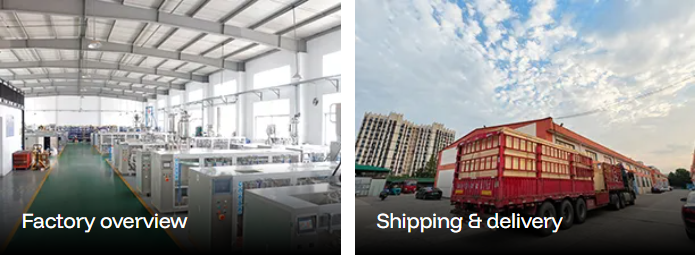
Huapack can develop complete packaging lines and turnkey projects around these requirements.
This is particularly useful when the customer does not want to coordinate several unrelated machinery suppliers. We can work around the pouch handling and final sealing process and build the line according to the actual factory layout and production target.
7. Why I Recommend Working with Huapack
Shanghai Huacheng Packing Machinery Company was established in 2015 in Songjiang District, Shanghai. From the beginning, our focus has been pouch packaging machinery.
We integrate R&D, manufacturing, sales, and technical service under one operation.
For me, this structure is valuable because packaging projects often involve small details that cross different departments. A product may need a different filling method. A pouch may require a different feeding adjustment. A customer may later want to connect the machine to a complete production line.
When these functions work together, it becomes easier to develop a solution around the actual application rather than selling a fixed machine and asking the customer to adapt their production around it.
Our experience covers:
Automatic Weighing Systems
Premade pouch filling machines
Pouch sealing systems
Vacuum and nitrogen packaging functions
Product coding
Complete pouch packaging lines
Customized packaging solutions
Turnkey packaging projects
I also believe that customization should have a reason.
If a customer only needs standard pouch filling, there is no reason to make the machine unnecessarily complicated. If the customer has unusual pouch dimensions, difficult product characteristics, or a complete line requirement, then customization becomes useful.
Our job is to find that balance.
8. FAQ: Premade Pouch Packaging Machine, 2-Nozzle Filling-210DG
What is the 2-Nozzle Filling-210DG?
The 210DG is an Automatic Premade Pouch Packaging Machine configured with two filling nozzles. It automatically handles pouch feeding, opening, product filling, sealing, and finished pouch discharge, with optional functions such as vacuum, nitrogen flushing, and coding.
What is the main advantage of using two filling nozzles?
The two-nozzle configuration allows suitable products to be filled through two filling points within the filling process. This can improve filling productivity compared with a single-nozzle setup.
Will two nozzles double the machine output?
Not necessarily. Complete machine output depends on the entire cycle. Pouch feeding, opening, filling time, sealing time, product properties, pouch dimensions, and other processes all affect the final production rate.
What pouches can the 210DG handle?
Depending on the final configuration and testing, it can be adapted for suitable stand-up pouches, zipper pouches, spout pouches, aluminum foil flat pouches, and other premade pouch formats.
Can I use printed pouches?
Yes. The machine is specifically designed to work with finished premade pouches, including printed pouches. This allows the pouch artwork to be prepared before the packaging stage.
Can it package granules?
Yes. Granular products such as nuts, snacks, seeds, and seasoning can be considered with an appropriate weighing or dosing system.
Can it fill powder?
Yes. Powder products can be handled with a suitable powder dosing system. The actual powder properties should be tested because flowability and dust behavior vary greatly from one product to another.
Can the machine fill liquid and paste products?
Yes, provided the filling system is correctly configured. Liquid and paste products may require pump-based filling, and viscosity, foaming, dripping, and shut-off behavior should be evaluated before final equipment selection.
Does it support vacuum packaging?
Vacuum functionality can be added for suitable applications where reduced air inside the pouch is part of the packaging process.
Can nitrogen flushing be installed?
Yes. Nitrogen flushing can be included when the product and packaging process require it. The exact gas process should be determined from the product and pouch requirements.
Can I add a date coding system?
Yes. Coding equipment can be integrated to print production dates, batch information, expiry information, or other required data.
Is it suitable for multi-SKU production?
Yes. Premade pouches are naturally suitable for brands with different printed packages and multiple SKUs. The exact changeover method depends on pouch dimensions, product type, and machine configuration.
What should I provide for a machine quotation?
I recommend providing the product name, product characteristics, filling weight, target output, pouch dimensions, pouch material, pouch type, and required functions.
If possible, send us actual product and pouch samples. This allows us to evaluate feeding, opening, filling, sealing, and discharge more accurately.
Can Huapack build a complete pouch packaging line?
Yes. We provide standalone machines as well as complete and turnkey pouch packaging solutions. Depending on the project, we can integrate weighing, feeding, filling, sealing, vacuum, nitrogen flushing, coding, inspection, conveying, and downstream packaging equipment.
Let Us Build the 210DG Around Your Product
I see the Premade Pouch Packaging Machine, 2-Nozzle Filling-210DG as a practical option for manufacturers that want to move from manual or semi-automatic pouch filling toward a more automated production process.
Its two-nozzle configuration provides a useful balance between filling productivity and machine size, while the premade pouch concept gives brands freedom to use different printed pouch designs and product SKUs.
But I would not recommend selecting this machine based only on the model name.
The right solution starts with your product and pouch.
Tell us what you are filling, how much you need to put into each pouch, what pouch you use, how many bags you need per hour, and whether you require vacuum, nitrogen flushing, coding, or downstream automation.
We can then evaluate the filling method and build the automatic premade pouch packaging machine around your actual production requirements.
If you are searching for a 2-nozzle pouch filling machine, premade pouch filling and sealing machine, automatic pouch packing machine for food, premade pouch packaging machine for multiple SKUs, or a complete premade pouch packaging line, the 210DG can be considered as part of a practical packaging solution.
Send us your pouch dimensions, product details, filling weight, target capacity, and required functions. If you can provide product and pouch samples, we can make the machine selection more precise and reduce the risk of choosing a filling system that does not match your real production conditions.
Source note: Product-specific information in this page is based on the Huapack 210DG configuration and the technical information supplied for this product. The comparison tables are engineering comparisons prepared from the supplied product information and standard pouch-packaging process principles. Actual capacity, filling accuracy, pouch compatibility, sealing performance, and final machine configuration should be confirmed through product and pouch testing before purchase.

 Español
 Portugues
 Pусский
 Français
 Deutsch
 日本語
日本語 한국어
한국어 العربية
 Italiano
 Nederlands
 Ελληνικά
 Svenska
 Polski
 ไทย
ไทย Türk dili
 हिन्दी
 Indonesia
 Melayu
 Tiếng Việt
 中文
中文 dansk
dansk Magyar
 қазақ
қазақ বাংলা
বাংলা עִברִית
 čeština
 Soomaali
 မြန်မာ
 فارسی
فارسی українська
 norsk
norsk Gaeilge
 беларускі
 Română
 ພາສາລາວ
 Filipino
 lietuvių
 Cymraeg
 македонски
 Suomalainen
 slovenský
 o'zbek
 اردو
اردو հայերեն
 Igbo
Igbo български
 سنڌي
سنڌي Shona
Shona සිංහල
සිංහල Hrvatski
 íslenskur
 galego
 català
 Zulu South Africa
 Afrikaans isiXhosa
 ಕನ್ನಡ
ಕನ್ನಡ lëtzebuergesch
 Indonésia Sunda
 Кыргызча
 тоҷикӣ
 Србија
 Twi
Twi Hawaii
 Cebu
Cebu नेपाल
नेपाल euskara
 frissi
 יידיש
יידיש latvija
 slovenija
 kiswahili
 ਪੰਜਾਬ
ਪੰਜਾਬ پښتو
پښتو საქართველოს
 hua moni
 bosna
bosna Kreyòl ayisyen
 Eesti
Eesti Gàidhlig na h-Alba
 Samoa
Samoa Монгол
 Azərbaycan
 አማራ
አማራ Shqipëria
 Malagasy
 Malta
Malta ខ្មែរ
ខ្មែរ Chicheva
 中文(繁体)
 ଓଡିଆ
ଓଡିଆ Setswana
 Afrikaans
 Aymara
 Башҡорт
 Türkmenler
 ትግሪኛ
ትግሪኛ Afaan Oromoo
 অসমীয়া
 Kinyarwanda
 Ilocano
 Wolof
Wolof अवधी
अवधी Oluganda
 Bikol
Bikol Fulɓe
Fulɓe Kikongo
 Sango
Sango ދިވެހި
 Lingala
 मैथिली
 Tsonga
 ꯃꯦꯏ ꯊꯥꯏ꯫
 brezhoneg
 Furlan
 नेवा
नेवा རྫོང་ཁ
 Santali
 Аҧсуа
Аҧсуа Нохчийн
 Чӑваш
Чӑваш Татар
Татар Batak Karo
 دری
دری Diura
Diura Fengyu
 Eʋegbe
 Iban
Iban Fiji
Fiji Tonga
Tonga Inuktitut
 Nahuatl
 maaya yucatec
 Runasimi
 guarani
 Qafar
Qafar Acholi
 Dinka
Dinka Luo
Luo Lundi
Lundi isiNdebele
 Tshivenḓa
 Sesotho sa Leboa
 Sesotho sa Borwa
 Ndumbe
 Papuan Pidgin
 Rromani ćhib
 Thok Nath





 WhatsApp
 Phone
Phone E-mail