
 Español
 Portugues
 Pусский
 Français
 Deutsch
 日本語
日本語 한국어
한국어 العربية
 Italiano
 Nederlands
 Ελληνικά
 Svenska
 Polski
 ไทย
ไทย Türk dili
 हिन्दी
 Indonesia
 Melayu
 Tiếng Việt
 中文
中文 dansk
dansk Magyar
 қазақ
қазақ বাংলা
বাংলা עִברִית
 čeština
 Soomaali
 မြန်မာ
 فارسی
فارسی українська
 norsk
norsk Gaeilge
 беларускі
 Română
 ພາສາລາວ
 Filipino
 lietuvių
 Cymraeg
 македонски
 Suomalainen
 slovenský
 o'zbek
 اردو
اردو հայերեն
 Igbo
Igbo български
 سنڌي
سنڌي Shona
Shona සිංහල
සිංහල Hrvatski
 íslenskur
 galego
 català
 Zulu South Africa
 Afrikaans isiXhosa
 ಕನ್ನಡ
ಕನ್ನಡ lëtzebuergesch
 Indonésia Sunda
 Кыргызча
 тоҷикӣ
 Србија
 Twi
Twi Hawaii
 Cebu
Cebu नेपाल
नेपाल euskara
 frissi
 יידיש
יידיש latvija
 slovenija
 kiswahili
 ਪੰਜਾਬ
ਪੰਜਾਬ پښتو
پښتو საქართველოს
 hua moni
 bosna
bosna Kreyòl ayisyen
 Eesti
Eesti Gàidhlig na h-Alba
 Samoa
Samoa Монгол
 Azərbaycan
 አማራ
አማራ Shqipëria
 Malagasy
 Malta
Malta ខ្មែរ
ខ្មែរ Chicheva
 中文(繁体)
 ଓଡିଆ
ଓଡିଆ Setswana
 Afrikaans
 Aymara
 Башҡорт
 Türkmenler
 ትግሪኛ
ትግሪኛ Afaan Oromoo
 অসমীয়া
 Kinyarwanda
 Ilocano
 Wolof
Wolof अवधी
अवधी Oluganda
 Bikol
Bikol Fulɓe
Fulɓe Kikongo
 Sango
Sango ދިވެހި
 Lingala
 मैथिली
 Tsonga
 ꯃꯦꯏ ꯊꯥꯏ꯫
 brezhoneg
 Furlan
 नेवा
नेवा རྫོང་ཁ
 Santali
 Аҧсуа
Аҧсуа Нохчийн
 Чӑваш
Чӑваш Татар
Татар Batak Karo
 دری
دری Diura
Diura Fengyu
 Eʋegbe
 Iban
Iban Fiji
Fiji Tonga
Tonga Inuktitut
 Nahuatl
 maaya yucatec
 Runasimi
 guarani
 Qafar
Qafar Acholi
 Dinka
Dinka Luo
Luo Lundi
Lundi isiNdebele
 Tshivenḓa
 Sesotho sa Leboa
 Sesotho sa Borwa
 Ndumbe
 Papuan Pidgin
 Rromani ćhib
 Thok Nath


Automatic Stand-Up Pouch Form Fill Seal Machine with 2-Nozzle Filling for High-Efficiency Flexible Packaging
When I help a factory choose a pouch packaging machine, I do not look at machine speed alone. I first look at the product, pouch size, film, filling volume, sealing method, changeover needs, and the way the machine will connect with the rest of the production line. That is how I approach the Stand-Up Pouch HFFS Packaging Machine, 2-Nozzle Filling-180SD/240SD/280SD/330SD.
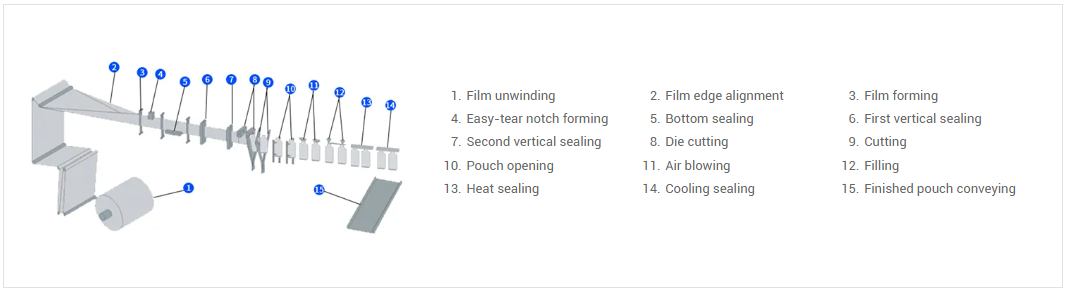
This machine is built around horizontal form-fill-seal technology, or HFFS. It takes roll film and turns it into finished stand-up pouches through an automated sequence of pouch forming, product filling, heat sealing, and cutting. The 2-nozzle filling configuration allows two filling points to work within the packaging cycle, making it a practical choice for factories looking for a more productive automatic stand-up pouch packaging solution.
I designed this product family for real production environments, not just for a machine showroom. The 180SD, 240SD, 280SD, and 330SD models provide different configuration options so I can match the machine to the required pouch dimensions, filling volume, film structure, and production target.
Stand-up pouches continue to attract attention because they combine flexible packaging with a convenient pouch shape. PMMI's flexible packaging research identifies format innovation, convenience-led pouch formats, specialty closures, automation, equipment flexibility, and footprint as important areas in the development of flexible packaging machinery.
```1. Why I Use HFFS Technology for Stand-Up Pouch Production
```In simple terms, HFFS means the machine forms the package horizontally while the packaging material moves continuously through the machine. Instead of purchasing a large quantity of pre-made empty bags, I can start with a roll of flexible film and let the machine create the pouch during production.
This makes a big difference when a factory wants to automate several steps in one process. The machine can bring together film feeding, pouch forming, filling, sealing, and cutting in a single production flow. There are fewer manual steps between an incoming roll of film and a finished pouch.
I find this especially useful for manufacturers producing multiple SKUs. A food factory, for example, may need different pouch sizes for sauces, ready-to-eat products, seasonings, or nutrition products. A personal care factory may need several pouch dimensions for creams, lotions, shampoo, or other liquid products. The machine can be configured around these actual requirements rather than forcing every customer into one fixed pouch size.
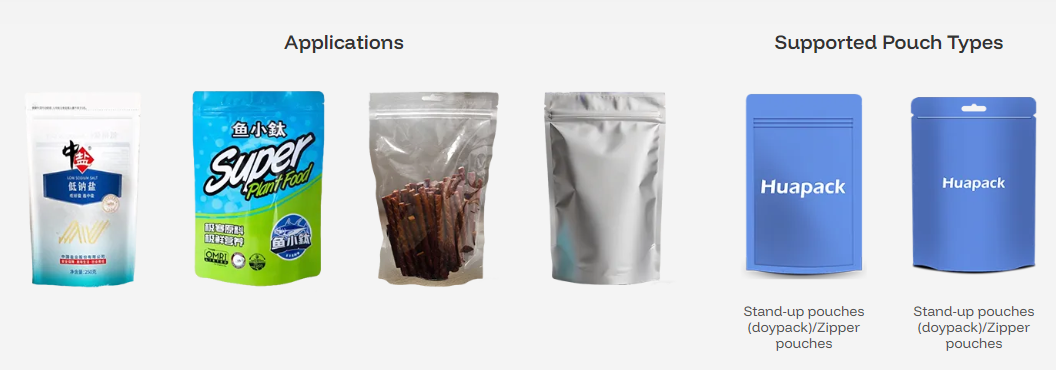
The stand-up pouch itself also offers a useful package shape. It can stand on a shelf, carry printed branding over a relatively large surface, and be designed with different opening or closing options depending on the application.
The Flexible Packaging Association notes that flexible packaging can be produced from paper, plastic film, aluminum foil, or combinations of these materials, and that flexible structures can provide barrier, strength, and sealing performance while using relatively thin material structures.
| Production Point | HFFS Stand-Up Pouch Machine | Pre-Made Pouch System |
|---|---|---|
| Packaging material | Roll film | Finished empty pouches |
| Pouch forming | Integrated into machine | Completed before the filling stage |
| Filling | Integrated 2-nozzle filling | Separate pouch feeding and filling |
| Sealing | Integrated heat sealing | Integrated or downstream depending on system |
| Format flexibility | Designed around selected pouch and film specifications | Depends on available pre-made pouch formats |
| Automation potential | High | High, but requires automatic pouch feeding |
Source: PMMI, 2019 Flexible Packaging Market Assessment, which discusses flexible packaging format innovation, stand-up pouches, equipment flexibility, automation, and machinery investment considerations. This table is a practical process comparison, not a universal productivity claim.
```2. How the 2-Nozzle Stand-Up Pouch Packaging Machine Works
```I like to explain the working principle in plain language because packaging machinery can sound more complicated than it really is. The machine follows a controlled sequence, and each section has one clear job.
Step 1: Roll Film Feeding
I load the selected flexible film onto the film-feeding section. The film is then pulled forward at a controlled speed. Stable film movement is important because even a small change in film position can affect pouch dimensions, printing alignment, or sealing.
Step 2: Pouch Forming
The film moves through the forming section, where it is shaped into the required stand-up pouch structure. The exact forming arrangement depends on the pouch design, film width, pouch dimensions, and other project requirements.
Step 3: Two-Nozzle Filling
This is one of the key differences in this machine configuration. The 2-nozzle filling system provides two filling points. Depending on the product and final machine design, this can help increase filling productivity compared with a single-nozzle arrangement.
I do not select the filling system based on nozzle quantity alone. I also check product viscosity, flow behavior, particle size if applicable, foaming, temperature, target filling volume, and the required filling accuracy. A machine that fills quickly but does not handle the actual product well is not a good machine.
Step 4: Heat Sealing
After filling, the pouch moves into the sealing section. Heat, pressure, and sealing time need to work together. Different film structures can require different sealing conditions, so I normally confirm the actual film before finalizing the sealing parameters.
Step 5: Cutting and Discharge
Once the pouch has been sealed, the cutting section separates the finished package. The completed stand-up pouch can then move to inspection, coding, secondary packaging, or another downstream process.
The whole idea is simple: film in, finished pouch out. My job is to make sure every step in between works smoothly with the customer's actual product and packaging material.
```3. Main Features I Consider Important in Daily Production
```Two-Nozzle Filling for Better Production Efficiency
The 2-nozzle design is useful when the product and required output justify two filling points. It gives the machine more filling capacity within each production cycle and can be particularly useful for factories moving from smaller-scale production toward higher-volume automated packaging.
Continuous Roll-Film Operation
I use roll film as the starting material rather than requiring pre-made pouches. This allows pouch forming and filling to happen within the same packaging system. It also gives the packaging engineer more control over pouch dimensions and film selection.
Intelligent Temperature Control
Good heat sealing is not simply about making the heater hotter. Too little heat may create a weak seal, while excessive heat can damage the film or create an unattractive seal. I therefore use temperature control to keep the sealing process within the selected operating range.
Color-Mark Tracking
When printed film is used, the color-mark tracking system helps the machine identify the registration mark. This allows the machine to control the position of the pouch relative to the printed artwork. It is a small feature that can make a big difference when appearance matters.
Multiple Film Options
Depending on the product and packaging specification, I can consider PE film, laminated film, aluminum foil laminate, and other suitable flexible structures. I always recommend film testing before mass production because the name of a film alone does not tell me enough about its sealing and forming behavior.
Designed for Automation
The machine can be integrated with upstream and downstream equipment. This can include product feeding, weighing or dosing, conveyors, coding, inspection, collection, and secondary packaging equipment. My goal is to make the pouch machine part of the production line rather than leave it operating as an isolated unit.
Model Options from 180SD to 330SD
The 180SD, 240SD, 280SD, and 330SD options give us a useful range for project planning. I do not recommend choosing the model simply because a larger number sounds better. The correct choice depends on pouch width, pouch height, fill volume, film width, product characteristics, and target output.
```4. Film, Sealing, and Pouch Quality: What I Check Before Production
```I often tell customers that the packaging machine and the packaging material are a team. If one side is wrong, the other side cannot completely fix the problem.
For example, two films may look almost identical but have different sealant layers. They can therefore behave differently during heat sealing. Film thickness, coefficient of friction, stiffness, surface treatment, barrier layers, and printing can also affect how the material runs through the machine.
This is why I prefer to test the actual film whenever possible. During testing, I look at film feeding, forming stability, registration, filling behavior, seal appearance, cutting accuracy, and pouch dimensions.
| Film Type | Typical Strength | Possible Applications | What I Need to Confirm |
|---|---|---|---|
| PE-based film | Flexible structure and heat-sealing potential | Selected food, household, and general packaging | Thickness, sealant behavior, stiffness, product compatibility |
| Laminated film | Can combine several performance properties | Food, nutrition, personal care, industrial products | Layer structure, barrier requirements, sealing layer |
| Aluminum foil laminate | Strong barrier potential | Selected food, pharmaceutical, and specialty applications | Barrier needs, sealing layer, forming behavior |
Source: Flexible Packaging Association. FPA describes flexible packaging as including plastic film, aluminum foil, paper, and combinations of these materials, with material structures engineered for functions such as barrier, strength, and sealing.
For me, pouch quality means more than a good-looking bag. I want consistent dimensions, clean filling, proper sealing, accurate cutting, and stable production over time. If the customer uses printed film, I also pay attention to registration accuracy.
For regulated applications, the packaging process may need additional validation. For example, ISO 11607-2:2019 covers development and validation requirements for forming, sealing, and assembly processes used for packaging terminally sterilized medical devices. The standard remains current and was confirmed by ISO in 2024, with a 2023 amendment addressing risk management.
```5. Where I See This Automatic Stand-Up Pouch Machine Being Used
```The biggest advantage of a flexible packaging machine is that it can serve many industries when the filling system and material are properly matched. I work with customers whose products are very different, so I never treat “stand-up pouch” as an industry by itself.
Food and Sauce Packaging
Sauces, seasonings, ready-to-eat foods, snacks, and other suitable food products can benefit from the stand-up pouch format. The large printable surface also gives brands room for product information and visual design.
Dairy and Nutrition Products
Suitable dairy, health nutrition, and medical nutrition products can be considered when the filling method, hygiene requirements, film structure, and production environment are appropriate.
Personal Care Products
Shampoo, conditioner, lotions, creams, body wash, facial products, and other suitable formulations are common candidates for flexible pouch packaging. The correct filling system depends strongly on viscosity and product behavior.
Pharmaceutical and Medical-Related Products
Certain pharmaceutical powders, medical consumables, and other products may use flexible packaging. However, regulated products require the packaging process, materials, equipment, and validation work to be considered together. I do not describe a general packaging machine as automatically compliant with a specific pharmaceutical or medical regulation.
Agrochemical Products
Compatible agrochemical formulations can also be packaged in flexible pouches when the film, sealing system, machine construction, and product safety requirements have been properly evaluated.
Pet Food
Pet food is another area where pouch packaging can be useful, especially for products where portion size, storage convenience, and easy handling are important.
PMMI's industry research has repeatedly highlighted food as an important flexible-packaging application while also identifying convenience and flexible pouch formats as key areas of development.
```6. How I Build and Test the Machine at Huapack
```Shanghai Huacheng Packing Machinery Company, known as Huapack, was established in 2015 and is based in Songjiang District, Shanghai. We bring research and development, manufacturing, sales, and technical service together under one operation, with a focused specialization in pouch packaging machinery.
That focus is important to me. I would rather understand one packaging field deeply than sell a little bit of everything without knowing the production details.
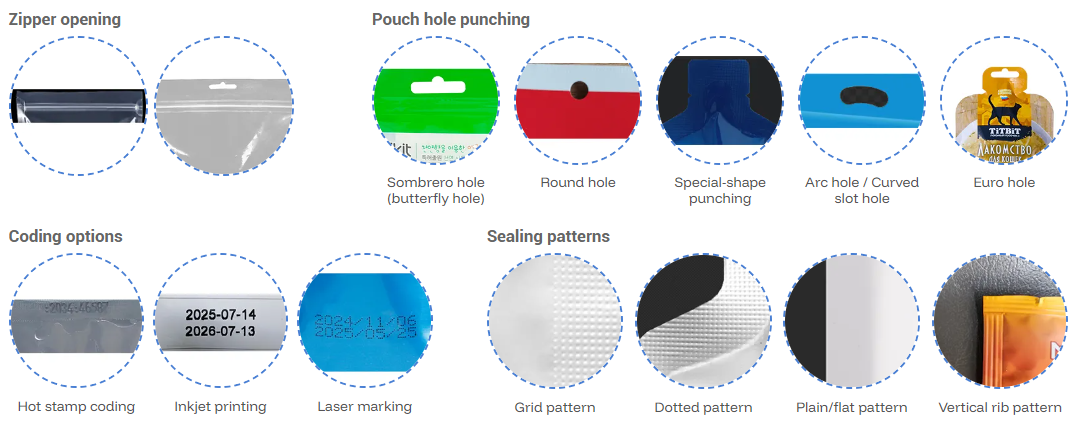
When I receive a new project, I start with basic questions: What is the product? What is the target pouch size? What is the filling quantity? What film will be used? Is the pouch printed? What output is required? Does the customer need a zipper, spout, special seal, or other pouch feature? How will the machine connect to the upstream and downstream equipment?
After that, our engineering team works on the machine configuration. Mechanical components, film-handling parts, forming sections, filling nozzles, sealing assemblies, sensors, control systems, and safety components all need to work together.
During assembly and testing, I pay attention to the details that affect real production. Film should move steadily. The forming section should maintain the required pouch shape. The two filling nozzles should work consistently. The sealing system should maintain stable conditions. Sensors should respond correctly. The finished pouch should meet the agreed dimensions.
| Test Area | What I Check | Production Goal |
|---|---|---|
| Film feeding | Film tension, movement, alignment | Stable material transport |
| Pouch forming | Shape, dimensions, film tracking | Consistent pouch formation |
| 2-nozzle filling | Flow, filling consistency, product behavior | Stable filling performance |
| Heat sealing | Temperature, pressure, seal appearance | Reliable package closure |
| Color-mark tracking | Registration response and cutting position | Correct printed-film alignment |
| Changeover | Adjustment and operator access | Practical multi-SKU operation |
Source: Huapack engineering and machine-design approach for pouch packaging projects. The process emphasis on forming, sealing, and validation is also consistent with the process-development principles addressed in ISO 11607-2 for applicable medical packaging applications.
```7. Why I Recommend Huapack for a Stand-Up Pouch Packaging Project
```I believe the most useful packaging supplier is not necessarily the one that gives the longest specification sheet. It is the one that can understand what happens before and after the machine.
At Huapack, our experience covers automated weighing, pouch filling, sealing, pouch handling, and complete packaging line integration. This allows me to look at the machine as part of a larger production system.
If a customer only needs a stand-up pouch HFFS machine, I can focus on that machine. If the customer needs a complete automated packaging line, I can work from product feeding through final sealing and downstream handling. This difference matters when a factory is building a new production line rather than simply replacing one old machine.
I also understand that every customer has different priorities. One factory may care most about output. Another may need fast SKU changeovers. Another may have limited floor space. A pharmaceutical customer may focus on process control and documentation. A food producer may care more about filling cleanliness and washdown requirements.
That is why I do not use one standard configuration for every customer. I use the 180SD, 240SD, 280SD, and 330SD platform as a starting point and then adjust the solution around the real project.
Current PMMI packaging machinery research continues to point toward automation, workforce considerations, sustainable materials, quality, sanitation, flexibility, and lifecycle support as important investment factors.
For me, this means a good machine should not only run well on the day it is installed. It should also be practical for operators, service technicians, and production managers to use over the long term.
```Frequently Asked Questions About the 2-Nozzle Stand-Up Pouch HFFS Machine
```1. What is a stand-up pouch HFFS packaging machine?
It is an automatic horizontal form-fill-seal machine that uses roll film to produce stand-up pouches. The machine integrates pouch forming, filling, heat sealing, and cutting into an automated packaging process.
2. What is the advantage of 2-nozzle filling?
Two filling nozzles provide two filling points within the machine's filling process. When the product and production target are suitable, this can support higher filling productivity than a single-nozzle configuration. The actual output still depends on product characteristics, filling volume, pouch size, film, and machine settings.
3. Can this machine package liquid products?
Yes, suitable liquid and semi-liquid products can be considered. Before confirming the filling system, I normally check viscosity, flow behavior, foaming, temperature, particles if present, and filling accuracy requirements.
4. Can it package powders?
The overall HFFS platform can be used for different product types when the correct filling system is selected. Powder products require a suitable dosing or filling method, so I would confirm the powder characteristics before selecting the final configuration.
5. What film materials can be used?
Suitable PE films, laminated films, and aluminum foil-based structures can be considered depending on the product and pouch design. The actual film construction should be tested for forming, feeding, sealing, and cutting performance.
6. Does the machine support printed packaging film?
Yes. The machine can be equipped with color-mark tracking for suitable printed films. This helps control the position of printed artwork during pouch forming and cutting.
7. How do I choose between 180SD, 240SD, 280SD, and 330SD?
I recommend starting with the pouch dimensions and filling requirements rather than the model number. Send me the pouch width and height, filling volume, film structure, product type, and target output. I can then help determine which model is the better fit.
8. Can Huapack provide a complete packaging line?
Yes. Huapack can work on complete pouch packaging solutions rather than only supplying one standalone machine. Depending on the project, the system can be designed around feeding, weighing, filling, sealing, conveying, inspection, and downstream packaging.
9. Can the machine be customized?
Yes. I treat customization as part of the engineering process. Pouch dimensions, filling method, film characteristics, production capacity, automation requirements, and line layout can all affect the final machine configuration.
10. What information should I provide before asking for a quotation?
I recommend providing the product name and characteristics, pouch size, filling volume or weight, film material and thickness if known, pouch drawing or sample, spout or zipper requirements if applicable, target production capacity, and any existing upstream or downstream equipment. The more accurate the information, the more useful the proposed machine configuration will be.
```Final Thoughts: I Build the Machine Around the Product, Not the Other Way Around
```The Stand-Up Pouch HFFS Packaging Machine, 2-Nozzle Filling-180SD/240SD/280SD/330SD is designed for manufacturers that want an automatic way to produce stand-up pouches from roll film while combining forming, filling, sealing, and cutting in one production system.
The 2-nozzle filling configuration gives this machine family a practical advantage for production environments where filling productivity matters. At the same time, I do not believe that nozzle quantity, machine speed, or model number alone should decide a packaging project.
The better question is: Will this machine work reliably with my product, pouch, film, filling volume, and production plan?
That is the question I try to answer at Huapack. From our Shanghai manufacturing base, we combine pouch packaging machine development, manufacturing, technical service, and complete-line integration. We can work with customers on individual machines or larger turnkey pouch packaging projects.
If you are searching for an automatic stand-up pouch packaging machine, 2-nozzle HFFS packaging machine, stand-up pouch filling and sealing machine, automatic pouch form fill seal machine, or a complete stand-up pouch packaging line, I recommend starting with your actual production data.
Send me your product information, pouch dimensions, filling volume, film structure, and target output. I will help you evaluate the most suitable 180SD, 240SD, 280SD, or 330SD configuration for your production line.
```



 WhatsApp
 Phone
Phone E-mail