Spouted Pouch Filling and Capping Machine-ZGY-6000
When I look at a pouch packaging project, I do not start with the machine alone. I start with the product, the pouch, the filling volume, the required output, and what the whole production line needs to do every day. This is especially important for spouted pouches because filling liquid or semi-liquid products is not simply a matter of putting material into a bag. The pouch has to be positioned correctly, the product has to be filled at a stable rate, and the cap needs to be tightened properly so the finished package does not leak.
That is the reason I developed the Spouted Pouch Filling and Capping Machine-ZGY-6000 as an integrated solution for premade spouted pouch packaging. It brings pouch feeding, positioning, filling, cap feeding, capping, inspection, and finished pouch discharge into one automated process. The machine is designed for customers who want to reduce manual work while keeping pouch quality and production consistency under control.
At Huapack, I focus on pouch packaging machinery rather than trying to cover every type of packaging equipment. Since our company was established in 2015 in Songjiang, Shanghai, I have built our approach around practical production needs: reliable pouch handling, stable filling, easy operation, sensible customization, and the ability to connect the machine with upstream and downstream equipment.
1. What the ZGY-6000 Is Designed to Do
The ZGY-6000 is an automatic spouted pouch filling and capping machine for premade stand-up or shaped pouches fitted with spouts. Instead of producing the pouch film and forming the bag on the machine, the system works with ready-made spouted pouches. This can make the packaging process easier to manage, especially for companies that already have a pouch supplier.
The working process is straightforward. Premade pouches enter the machine, are picked and positioned, and then move through the filling station. The filling system delivers the required product into the pouch. After filling, the cap is supplied and tightened automatically. The finished pouch is then discharged for the next production step.
For the ZGY-6000, the published machine specification lists a maximum pouch size of 85 × 150 mm, a maximum filling volume of 150 ml, and a packaging speed of up to 150 pouches per minute. These figures are reference machine specifications rather than a promise of the same output for every product. Real production speed depends on filling volume, material flow, pouch design, cap type, and other production conditions.
| Reference Specification | ZGY-6000 | Why It Matters |
|---|
| Model | ZGY-6000 | High-output spouted pouch filling and capping configuration |
| Maximum pouch size | 85 × 150 mm | Defines the applicable premade pouch range |
| Maximum filling volume | 150 ml | Useful for small and medium-volume liquid packs |
| Packaging speed | ≤150 pouches/min | Reference maximum under specified operating conditions |
| Machine dimensions | 2970 × 3300 × 2500 mm | Important for factory layout planning |
| Net weight | Approx. 1500 kg | Relevant for installation and floor planning |
Source: Huapack published ZGY-6000 specifications and product information. Actual production performance should be confirmed through product and pouch testing before final equipment selection.
One thing I always recommend is testing the actual product before deciding on the final filling configuration. A thin juice and a thick sauce may both be called “liquid products,” but they behave very differently inside a filling system.
2. How the Spouted Pouch Filling and Capping Process Works
The basic operating sequence is automatic, but each step has an important job.
Pouch feeding: Premade spouted pouches are loaded into the feeding system.
Pouch positioning: The machine moves each pouch into the correct position before filling.
Detection: Sensors help check pouch presence and position. A no-bag-no-fill function can prevent unnecessary product discharge when a pouch is missing.
Filling: The selected filling system delivers the product into the pouch according to the set filling parameters.
Cap feeding: Caps are automatically supplied to the capping station.
Capping: The cap is placed and tightened to create a secure closure.
Discharge: Finished pouches leave the machine and can move to inspection, coding, cartoning, or another downstream process.
For a production operator, the important part is that these steps work together. If pouch positioning is unstable, filling accuracy can suffer. If the pouch is not held properly, the filling nozzle may not enter the spout cleanly. If the cap is not handled correctly, leakage can occur later even when the filling process itself is accurate.
Spouted pouch packaging is attractive because the pouch combines flexible packaging with a resealable dispensing opening. Industry packaging sources describe spouted pouches as suitable for liquids and semi-liquid products where controlled dispensing and resealing are useful.
| Production Step | What I Focus On | Typical Production Concern |
|---|
| Pouch feeding | Stable pouch supply | Missed or double pouch feeding |
| Positioning | Accurate pouch location | Spout and pouch center alignment |
| Filling | Stable product delivery | Foam, viscosity, dripping, or volume variation |
| Cap feeding | Consistent cap supply | Cap orientation or shortage |
| Capping | Secure closure | Loose or over-tightened caps |
| Discharge | Smooth finished pouch transfer | Product contact or pouch deformation |
Source: Process structure is based on Huapack's published machine functions, including automatic pouch supply, photoelectric detection, quantitative filling, cap supply, automatic capping, and finished pouch discharge.
3. Why I Use Premade Spouted Pouches for This Machine
One practical advantage of the ZGY-6000 is that it is designed around premade spouted pouches. This means the customer does not need to combine pouch film forming and filling into the same machine. The pouch arrives ready for filling and capping.
For a company that already purchases finished pouches, this can simplify production planning. It also gives the packaging team more freedom to work with different pouch shapes, printed designs, spout positions, and materials, provided the pouch specifications are compatible with the machine.
I also like the format from the user's point of view. A bottle can be rigid and bulky, while a spouted pouch can be lighter and easier to squeeze or pour. The pouch can also be shipped and stored efficiently before filling because it does not take the same rigid shape as a filled bottle. Packaging industry references commonly identify lower weight, compact storage, portability, and controlled dispensing as reasons for using spouted pouches.
| Packaging Format | Typical Strength | Potential Limitation | Where It Fits Well |
|---|
| Spouted pouch | Lightweight, squeezable, resealable | Requires controlled pouch handling | Sauces, drinks, detergents, personal care |
| Rigid bottle | Strong and familiar | More rigid packaging volume | Beverages, cleaners, oils |
| Jar | Wide opening and easy access | Less convenient for controlled pouring | Thick sauces, creams, pastes |
| Flat sachet | Compact single-use format | Usually less convenient for resealing | Samples, single-use products |
Source: General packaging-format comparison synthesized from packaging industry references describing spouted pouch structure, dispensing, storage, transportation, and resealing characteristics.
4. The Main Features I Built Around Production Reality
I do not see automation as simply adding more motors and sensors. Good automation should make daily production easier for the people operating the machine.
Automatic pouch handling reduces the need for operators to manually position every pouch. The machine handles the pouch in a repeated sequence, which helps create a more consistent production rhythm.
Photoelectric detection provides an additional control point. The published ZGY series information includes pouch detection and a no-bag-no-fill function. This is a simple idea, but it is valuable because filling without a correctly positioned pouch can create product waste and cleaning work.
Automatic quantitative filling helps reduce manual filling work. For products such as juice, yogurt, honey, sauces, cleaning liquids, and similar materials, stable dosing is an important part of finished package quality.
Automatic cap supply and capping complete the package without requiring an operator to manually close each pouch. Proper closure matters because the pouch is often expected to be carried, stored, squeezed, or poured after production.
Touch-screen operation gives operators a more direct way to adjust machine settings. For production teams handling several pouch sizes or products, parameter management is especially useful.
Of course, no filling machine can solve every product problem automatically. Highly viscous materials, products containing particles, foaming liquids, temperature-sensitive products, and aggressive chemicals may require a specific filling design. That is why I prefer to confirm the product characteristics before finalizing the machine configuration.
5. Where I See the ZGY-6000 Being Used
The machine is suitable for many industries because its main task is handling liquid and semi-liquid products in premade spouted pouches.
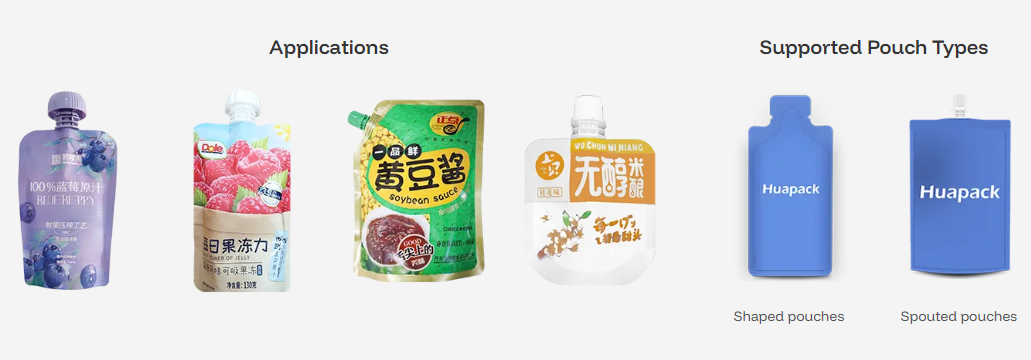
In food and beverage packaging, typical applications include fruit juice, yogurt, jam, honey, sauces, ketchup, chili sauce, salad dressing, and other liquid or paste-like products. Spouts make these products easier to pour and reseal.
In personal care and household chemicals, the machine can be considered for products such as laundry detergent, shampoo, hair-care products, liquid soap, and cleaning agents. The correct pouch material and product-contact parts must be selected according to the chemical properties of the product.
In health nutrition and pharmaceutical-related applications, liquid nutrition products and certain external-use liquid or paste products can be packaged in spouted pouches where the package format and regulatory requirements are suitable.
In agrochemical and industrial products, liquid fertilizers, nutrient solutions, lubricants, pigment slurries, and other compatible liquid products may also be candidates. However, these applications need more careful material compatibility checks. A machine suitable for food products should not automatically be assumed suitable for every chemical product.
My rule is simple: the machine should be matched to the product, not the other way around.
6. Manufacturing, Customization and Full-Line Integration
When I manufacture a pouch packaging machine, I pay attention to more than the external appearance. The machine has to survive repeated production cycles, be accessible for cleaning and maintenance, and provide operators with a clear working process.
Our engineering work covers the mechanical structure, pouch handling, filling system, control system, cap handling, safety functions, and line connection. Depending on the project, I can also work with customers on upstream and downstream equipment so the pouch filler does not become an isolated machine in the middle of the factory.
This matters when production grows. A customer may start with one machine and later add conveyors, inspection systems, coding equipment, secondary packaging, or other automation. A properly planned pouch packaging line can make future expansion easier.
For customization, I normally look at several factors first:
Pouch width and height
Filling volume
Product viscosity and flow behavior
Product temperature
Presence of particles or solid pieces
Spout and cap design
Required production capacity
Cleaning requirements
Available factory space
Connection with existing production equipment
The published ZGY-6000 configuration uses six filling nozzles and lists a maximum packaging speed of up to 150 pouches per minute. In practice, I would still recommend a real product test before using the maximum figure for production planning.
7. Why I Choose Huapack for Spouted Pouch Packaging Projects
At Shanghai Huacheng Packing Machinery Company, we focus on pouch packaging machinery. I believe that specialization is important because pouch packaging has its own problems: flexible bags move differently from rigid containers, spouts need accurate handling, filling behavior changes with the product, and the final cap must be secure.
Since 2015, our work has covered research and development, manufacturing, sales, and technical service. From our base in Songjiang District, Shanghai, we support customers looking for standalone pouch machines as well as complete packaging lines.
More importantly, I do not want to sell a machine based only on a specification sheet. I want to understand what you are actually producing. A machine that looks fast on paper may not be the best choice if your sauce is very thick, your pouch is difficult to handle, or your production space is limited.
My approach is to start with your pouch and product, confirm the filling and capping requirements, then work backward toward the machine configuration. This makes the final solution more practical and reduces the risk of choosing equipment that does not match the real production environment.
For customers who need more than a single machine, Huapack can also develop turnkey pouch packaging solutions, including machine integration and production-line planning. This is useful when the goal is not simply to automate filling but to create a stable pouch packaging operation from pouch handling through final packaging.
8. Spouted Pouch Filling and Capping Machine FAQ
What products can the ZGY-6000 package?
The machine is designed for liquid and semi-liquid materials. Potential applications include juice, yogurt, honey, jam, sauces, detergents, personal care liquids, nutrition products, and other compatible products. The actual filling system should be selected according to viscosity, temperature, particles, foaming behavior, and other product characteristics.
Does the machine make the pouch?
No. The ZGY-6000 is designed for premade spouted pouches. It focuses on pouch feeding, positioning, filling, capping, and finished pouch discharge. This makes it suitable for manufacturers that already purchase finished spouted pouches.
What is the maximum filling volume?
The published ZGY-6000 specification lists a maximum filling volume of 150 ml and a maximum pouch size of 85 × 150 mm. The final usable range should be confirmed according to the actual pouch and product.
Can the machine fill thick products?
It can be considered for suitable pastes and viscous products, but thickness alone is not enough to select the filling system. I would check viscosity, flow behavior, temperature, particle size, and required filling accuracy before recommending the final configuration.
Can the ZGY-6000 be connected to a complete packaging line?
Yes. Huapack develops pouch packaging solutions beyond standalone equipment. The machine can be planned for connection with suitable upstream or downstream equipment, depending on the customer's production process, floor layout, and automation requirements.
How fast can the ZGY-6000 run?
The published specification lists a maximum packaging speed of up to 150 pouches per minute. This should be treated as a reference maximum rather than a guaranteed output for every application. Product properties, pouch design, filling volume, cap type, and operating conditions all affect actual production speed.
How do I choose the right spouted pouch filling machine?
I recommend starting with five basic questions: What is the product? What is the filling volume? What pouch size and spout are being used? What production capacity is required? And what equipment must the machine connect to? Once these points are clear, it becomes much easier to select the right filling method, pouch handling system, capping arrangement, and automation level.
Let Me Build the Right Pouch Packaging Solution for Your Product
The Spouted Pouch Filling and Capping Machine-ZGY-6000 is built for one clear purpose: to make the filling and capping of premade spouted pouches faster, more consistent, and less dependent on manual work.
Its automatic pouch feeding, detection, filling, cap feeding, capping, and discharge functions make it a practical choice for liquid and semi-liquid pouch packaging. More importantly, I can adapt the packaging solution around the actual product, pouch, production target, and factory layout rather than treating every customer as the same.
If you are comparing a spouted pouch filling machine, automatic pouch filling and capping machine, or premade spout pouch packing machine, I suggest sending us your pouch sample, product information, filling volume, and target output. With those details, I can help determine whether the ZGY-6000 is the right fit and what configuration your production line actually needs.
Huapack — from one pouch machine to a complete pouch packaging line.
Reference Sources
Huapack, “Rotary Spout Pouch Filling Capping Machine,” including ZGY-6000 functions and specifications.
ETW International, “Spouted Pouch Filling & Capping Machine (150ml, 85×150mm),” including published ZGY-6000 specifications.
Huapack Group, published ZGY series machine information and comparison data.
BioPackTech, technical overview of spouted pouch structure, applications, dispensing, and packaging advantages.
Red Dot Packaging, overview of spouted pouch materials, applications, logistics, and dispensing characteristics.

 Español
 Portugues
 Pусский
 Français
 Deutsch
 日本語
日本語 한국어
한국어 العربية
 Italiano
 Nederlands
 Ελληνικά
 Svenska
 Polski
 ไทย
ไทย Türk dili
 हिन्दी
 Indonesia
 Melayu
 Tiếng Việt
 中文
中文 dansk
dansk Magyar
 қазақ
қазақ বাংলা
বাংলা עִברִית
 čeština
 Soomaali
 မြန်မာ
 فارسی
فارسی українська
 norsk
norsk Gaeilge
 беларускі
 Română
 ພາສາລາວ
 Filipino
 lietuvių
 Cymraeg
 македонски
 Suomalainen
 slovenský
 o'zbek
 اردو
اردو հայերեն
 Igbo
Igbo български
 سنڌي
سنڌي Shona
Shona සිංහල
සිංහල Hrvatski
 íslenskur
 galego
 català
 Zulu South Africa
 Afrikaans isiXhosa
 ಕನ್ನಡ
ಕನ್ನಡ lëtzebuergesch
 Indonésia Sunda
 Кыргызча
 тоҷикӣ
 Србија
 Twi
Twi Hawaii
 Cebu
Cebu नेपाल
नेपाल euskara
 frissi
 יידיש
יידיש latvija
 slovenija
 kiswahili
 ਪੰਜਾਬ
ਪੰਜਾਬ پښتو
پښتو საქართველოს
 hua moni
 bosna
bosna Kreyòl ayisyen
 Eesti
Eesti Gàidhlig na h-Alba
 Samoa
Samoa Монгол
 Azərbaycan
 አማራ
አማራ Shqipëria
 Malagasy
 Malta
Malta ខ្មែរ
ខ្មែរ Chicheva
 中文(繁体)
 ଓଡିଆ
ଓଡିଆ Setswana
 Afrikaans
 Aymara
 Башҡорт
 Türkmenler
 ትግሪኛ
ትግሪኛ Afaan Oromoo
 অসমীয়া
 Kinyarwanda
 Ilocano
 Wolof
Wolof अवधी
अवधी Oluganda
 Bikol
Bikol Fulɓe
Fulɓe Kikongo
 Sango
Sango ދިވެހި
 Lingala
 मैथिली
 Tsonga
 ꯃꯦꯏ ꯊꯥꯏ꯫
 brezhoneg
 Furlan
 नेवा
नेवा རྫོང་ཁ
 Santali
 Аҧсуа
Аҧсуа Нохчийн
 Чӑваш
Чӑваш Татар
Татар Batak Karo
 دری
دری Diura
Diura Fengyu
 Eʋegbe
 Iban
Iban Fiji
Fiji Tonga
Tonga Inuktitut
 Nahuatl
 maaya yucatec
 Runasimi
 guarani
 Qafar
Qafar Acholi
 Dinka
Dinka Luo
Luo Lundi
Lundi isiNdebele
 Tshivenḓa
 Sesotho sa Leboa
 Sesotho sa Borwa
 Ndumbe
 Papuan Pidgin
 Rromani ćhib
 Thok Nath






 WhatsApp
 Phone
Phone E-mail