# Servo Driven Flexible Pouch Packaging Machine, Continuous Motion-240SDZ/280SDZ/330SDZ
When I design a flexible pouch packaging machine, I always start with one simple question: What does the customer need to produce every day? Speed matters, but speed alone does not make a good packaging machine. The film must move smoothly, the pouch must stay in position, the product must be filled correctly, and every seal must be clean and strong.
That is why I developed the Servo Driven Flexible Pouch Packaging Machine, Continuous Motion in the 240SDZ, 280SDZ, and 330SDZ configurations. These machines use a full servo motion system and a continuous-motion working principle to bring film forming, pouch transport, filling, sealing, cutting, and coding into one automated packaging process.
At Shanghai Huacheng Packing Machinery Company (Huapack), I focus on pouch packaging machinery. Since 2015, we have combined R&D, manufacturing, sales, and technical service in Songjiang, Shanghai. I work with customers across food, dairy, nutrition, pharmaceutical, personal care, agrochemical, pet food, and industrial applications.
My goal is not to make the most complicated machine. My goal is to make a machine that is easy to understand, stable in daily production, and flexible enough to grow with the customer's business.
1. What Is the Continuous Motion Servo Pouch Packaging Machine?
The Servo Driven Flexible Pouch Packaging Machine is a horizontal form-fill-seal system designed to produce flexible pouches from roll film. Unlike a simple intermittent machine that repeatedly starts and stops its main movement, a continuous-motion design keeps the main transport process moving in one direction while the different packaging stations work together.
For me, this is important because fewer unnecessary back-and-forth movements can make the production process smoother, especially when the machine is working at higher speeds. The published product information describes the system as using a continuous one-direction motion principle, with the working units moving in the same direction during the packaging cycle.
The machine uses independent servo motors for key motion axes. This gives the control system a much better way to manage film feeding, pouch transport, forming, sealing, and other synchronized movements.
In simple terms, I can tell the machine exactly how far a film should move, how fast a station should operate, and when one movement needs to work together with another. That makes digital production adjustment much more practical.
The machine can also be configured with different filling systems according to the product. This is important because a bag of nuts, a pouch of protein powder, and a package of liquid sauce do not behave the same way during filling.
| Model | Pouch Size Range (W × H) | Max. Filling Volume | Reference Packaging Speed |
|---|
| 240SDZ | 90 × 125 to 120 × 250 mm | 500 ml | 60–120 bags/min |
| 280SDZ | 90 × 125 to 140 × 250 mm | 500 ml | 60–100 bags/min |
| 330SDZ | 90 × 125 to 165 × 250 mm | 700 ml | 60–90 bags/min |
Source: Huapack published specifications for the duplex roll-film Zipper Pouch Packaging Machine. Actual output depends on product characteristics, pouch material, filling system, and production conditions.
2. How I Make Continuous Motion Work in a Real Packaging Process
From the outside, the machine looks like a long automated production line. Inside, several steps have to happen at exactly the right time.
Film unwinding: Roll film enters the machine from the film supply section.
Film alignment: The film is guided and positioned before pouch forming.
Pouch forming: The film is shaped into the required pouch structure.
Pouch transport: Grippers or a walking-beam transport system move the formed pouch through the working stations.
Filling: The selected filling system delivers the product into the pouch.
Sealing: The pouch passes through the sealing stages to close the package.
Cutting and finishing: The individual pouches are separated and can receive additional features such as notches or holes.
Coding and discharge: Date codes, QR codes, barcodes, or other information can be added before finished pouches leave the machine.
The walking-beam transport principle is particularly useful because the pouch is held by grippers and transferred from one station to another. Huapack's published information describes this transport method as moving pouches through the forming, filling, and closing stages.
At the same time, the full servo system gives me independent control over different motion axes. This is useful when one packaging station needs to move at a different speed or position from another station.
For example, if I need to change the pouch length, I do not want the operator spending hours changing mechanical parts. The published machine information highlights digital specification switching and recipe-based parameter adjustment as ways to simplify format changes.
That is one of the biggest practical benefits of modern servo pouch packaging: the operator spends more time setting the machine and less time fighting with it.
3. 240SDZ, 280SDZ or 330SDZ? I Choose by Pouch Size and Production Need
I do not recommend choosing a model simply because its number looks larger. The correct model depends on the pouch dimensions, filling volume, desired output, and the product itself.
The 240SDZ is a good fit when the required pouch width and filling volume are relatively moderate. Its published pouch range is 90 × 125 mm to 120 × 250 mm, with a maximum listed filling volume of 500 ml and a reference speed of 60–120 bags per minute.
The 280SDZ gives a wider pouch format, with a published range from 90 × 125 mm to 140 × 250 mm. Its listed maximum filling volume is 500 ml and its reference speed is 60–100 bags per minute.
The 330SDZ provides the largest pouch width among these three models. The published range reaches 165 × 250 mm, with a maximum listed filling volume of 700 ml and a reference speed of 60–90 bags per minute.
| Selection Point | 240SDZ | 280SDZ | 330SDZ |
|---|
| Maximum pouch width | 120 mm | 140 mm | 165 mm |
| Maximum pouch height | 250 mm | 250 mm | 250 mm |
| Maximum filling volume | 500 ml | 500 ml | 700 ml |
| Reference speed | 60–120 bags/min | 60–100 bags/min | 60–90 bags/min |
| Typical selection reason | Smaller pouch format and higher cycle demand | Wider pouch requirement | Larger pouch width and filling volume |
Source: Huapack published model specifications. “Typical selection reason” is an engineering interpretation based on the listed pouch dimensions, volume, and speed; final model selection should be confirmed using actual pouch and product samples.
I always recommend testing the actual packaging material before making the final decision. A product's density, flow, viscosity, pouch film, zipper structure, and required filling accuracy can change the best machine configuration.
4. What the Full Servo System Gives Me in Daily Production
The biggest advantage of a servo-driven packaging machine is not simply the word “servo” on the specification sheet. What matters is how the servo system changes the way the machine behaves.
First, I get better motion control. Each important axis can be controlled separately, while the complete system keeps those movements synchronized.
Second, I can make production settings digitally. Bag length, speed, and other parameters can be managed through the HMI instead of relying mainly on mechanical adjustment.
Third, changeover becomes easier. When a factory handles several pouch specifications, recipe storage can save a lot of operator time. The published machine information states that operators can select a stored recipe and have the machine automatically adjust related parameters, reducing changeover from a long manual process to a much shorter setup.
Fourth, continuous movement helps the machine run smoothly. The continuous-motion design avoids traditional reciprocating movement as the main transport principle. That can be valuable when the machine needs to maintain a steady production rhythm.
Fifth, I can build the filling section around the product. The machine's modular approach allows different filling systems to be used according to product characteristics.
| Feature | Traditional Manual Adjustment | Servo-Controlled Packaging | Practical Benefit |
|---|
| Bag length | Mechanical adjustment may be needed | Digital parameter setting | Faster format adjustment |
| Motion control | More dependent on mechanical transmission | Independent servo axes | Better synchronization |
| Recipe management | Manual recording or adjustment | Recipe-based settings | Easier repeat production |
| Film positioning | Mechanical alignment | Servo-controlled movement with sensors | More consistent pouch forming |
| Production changeover | Can take more operator time | Digital parameter switching | Reduced setup work |
Source: Comparison based on Huapack's published servo pouch machine features, including independent servo motion, digital specification switching, recipe control, and automatic film alignment options.
5. Flexible Packaging Features I Can Add to the Machine
I know that different products need different pouch designs. That is why I treat optional functions as part of the packaging solution rather than as random add-ons.
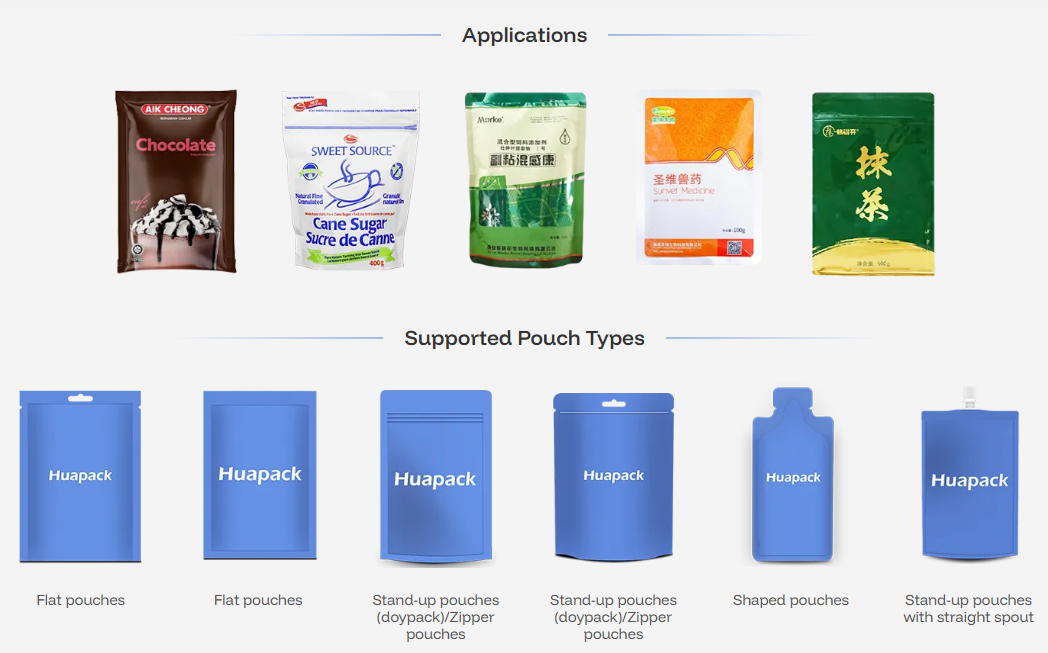
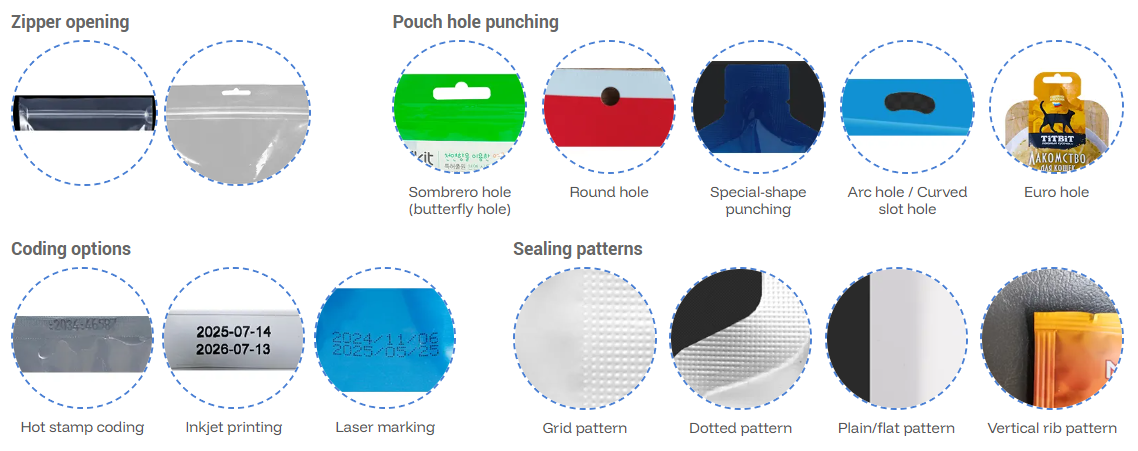
Zipper packaging can be used when the finished pouch needs to be opened and closed repeatedly. This is common for snacks, pet food, coffee, nuts, powders, and other products where the customer may not use the whole package at once.
Easy-open notches can make the pouch easier to tear by hand.
Hanging holes such as round or Euro holes can be added when the product needs to be displayed on retail hooks.
Film alignment can be added as an option to help keep the printed film in the correct position.
Double-head filling can be considered for larger packages where the filling process needs to be accelerated.
Bag support can help with larger or heavier pouches.
Finished-product conveyors can transfer completed pouches to the next stage of the line.
The published Huapack configuration lists these options, along with coding choices such as cold pressing, touch coding, QR codes, and barcodes.
For sealing, I can also consider different sealing patterns, including plain, grid, dotted, and vertical rib patterns, depending on the film and package appearance required.
6. What Products Can I Package With It?
The answer depends on the filling system, but the machine is suitable for a broad range of products.
Food and Snack Products
For food factories, I can configure the system for products such as nuts, grains, coffee beans, snacks, seasoning, dried foods, and similar materials. Weighing systems can be integrated upstream when accurate portion control is required.
Pet Food
Pet food is a natural application for zipper stand-up pouches. The pouch can provide convenient opening and closing, while the automated filling and sealing process reduces repetitive manual work.
Powders
Protein powder, milk powder, spices, detergent powder, and agricultural powder products can be handled with an appropriate powder filling system. Powder density and dust behavior need to be checked before selecting the final dosing method.
Agricultural Products
Seeds, animal feed, organic fertilizer, and similar materials can be packaged in flexible pouches. For dusty or irregular products, I pay special attention to the filling and sealing areas because product residue around the seal can cause quality problems.
Industrial Materials
Plastic granules, chemical additives, building-material powders, and other compatible industrial materials can also be packaged. For chemical products, I always recommend checking product-contact materials and film compatibility before finalizing the machine.
The published Huapack product information specifically lists powders such as milk powder and protein supplements and granules such as coffee beans, nuts, and pet food among suitable products.
7. How I Build and Customize the Machine for a Real Factory
I believe the best packaging machine is one that fits the factory, not one that forces the factory to change everything around it.
When I work on a new project, I normally begin with the product and pouch. I want to know the product's density, particle size, moisture, viscosity, temperature, and flow behavior. I also need the pouch dimensions, film structure, zipper or other features, filling weight, target output, and required packaging appearance.
Then I look at the production line. Does the customer already have a weighing machine? Is there an automatic product feeder? Does the finished pouch need metal detection, check weighing, cartoning, or case packing? Is the machine going into a small workshop or a large automated factory?
These questions sound basic, but they can prevent expensive mistakes.
During manufacturing, I pay attention to the frame, film path, transport mechanism, servo motors, sensors, sealing system, filling system, control cabinet, HMI, and safety functions. The machine must not only work during a factory test. It should also be practical to operate and maintain after installation.
For example, the published 240SDZ machine dimensions are approximately 7200 × 970 × 1460 mm, while the 280SDZ is approximately 8500 × 1100 × 1460 mm and the 330SDZ is approximately 9500 × 1100 × 1460 mm. This means factory space should be considered early, not after the machine has already been ordered.
I can also design the equipment for integration with upstream weighing and feeding systems and downstream conveying, inspection, or secondary packaging equipment. This is particularly useful when a customer wants a complete automatic flexible pouch packaging line rather than a standalone pouch machine.
8. Why I Choose Huapack for Servo Pouch Packaging Projects
At Huapack, I focus on pouch packaging machinery. That specialization helps me understand the small details that can make a big difference in production.
Shanghai Huacheng Packing Machinery Company was established in 2015 in Songjiang District, Shanghai. We combine R&D, manufacturing, sales, and technical service under one operation. This allows me to work with customers through the full process rather than treating equipment supply as a one-time transaction.
I can support projects ranging from one servo driven flexible pouch packaging machine to a complete turnkey pouch packaging line.
My approach is practical. If a customer only needs a simple machine, I do not want to make the system unnecessarily complicated. If the customer needs high-speed production, multiple pouch sizes, automatic weighing, inspection, and secondary packaging, I can build the project around those requirements.
I also believe product testing is important. A specification sheet can tell me the maximum pouch size and reference speed, but it cannot tell me exactly how your powder flows, how sticky your sauce is, or how your film behaves during sealing.
That is why I encourage customers to provide product samples, pouch samples, film information, and target production data. These details help me select a more suitable filling system and machine configuration.
9. Frequently Asked Questions
What is the difference between 240SDZ, 280SDZ, and 330SDZ?
The main differences are pouch width, filling volume, reference speed, and machine size. The 240SDZ supports up to 120 mm pouch width and 500 ml listed filling volume; the 280SDZ supports up to 140 mm and 500 ml; and the 330SDZ supports up to 165 mm and 700 ml.
What does continuous motion mean?
It means the main pouch transport process is designed around continuous one-direction movement rather than repeated traditional reciprocating movement. The published product description states that the working units move in the same direction during the packaging process.
No. The 240SDZ, 280SDZ, and 330SDZ are designed as roll-film forming, filling, and sealing systems. The machine starts with packaging film on a roll and forms the flexible pouch during the process.
Can the machine make zipper pouches?
Yes. The published configuration is designed for roll-film zipper doypack packaging, and zipper packaging is one of the main application formats.
Can I package different products on the same machine?
In many cases, yes, provided the products and pouch formats are compatible with the machine configuration. The filling system may need to be changed or adjusted for different materials. Recipe management can also make repeated product changes easier.
Can I change pouch specifications digitally?
Yes. Digital specification switching is one of the machine's design features. The operator can use the HMI and stored parameters to reduce manual adjustment during product changeover.
What is the maximum packaging speed?
The published reference speed is 60–120 bags/min for the 240SDZ, 60–100 bags/min for the 280SDZ, and 60–90 bags/min for the 330SDZ. These are reference specifications, not guaranteed production speeds for every product. Actual output depends on filling volume, product behavior, film, pouch structure, and machine configuration.
Can Huapack build a complete packaging line?
Yes. Huapack can develop solutions around automated weighing, pouch filling, sealing, conveying, inspection, and other packaging equipment. The final configuration is based on the customer's product, pouch format, capacity target, and factory layout.
Let's Build the Right Flexible Pouch Packaging Line
The Servo Driven Flexible Pouch Packaging Machine, Continuous Motion-240SDZ/280SDZ/330SDZ is designed for manufacturers who want more control over pouch production without making daily operation unnecessarily complicated.
With full servo motion, continuous pouch transport, digital specification adjustment, modular filling options, zipper pouch capability, multiple sealing choices, and line-integration potential, the machine can support a wide range of modern flexible packaging applications.
But I do not recommend choosing a machine from the model number alone.
If you are looking for an automatic servo pouch packaging machine, continuous motion pouch packaging machine, servo driven flexible pouch packing machine, roll film zipper pouch packaging machine, or high speed doypack filling and sealing machine, send me your product information, pouch dimensions, filling weight or volume, film details, and target output.
I can then help you compare the 240SDZ vs 280SDZ vs 330SDZ, select the right filling system, and plan the machine around your actual production conditions.
Huapack — focused on pouch packaging, from individual machines to complete automated packaging lines.
Technical and Product References
Huapack, “Zipper Pouch Packing Machine,” including 180SDZ, 240SDZ, 280SDZ, and 330SDZ specifications and application information.
Huapack, “Zipper Doypack Pouch Packing Machine,” including full servo motion, walking-beam transport, sealing functions, and model parameters.
ETW International, “Servo Driven Flexible Pouch Packaging Machine, Continuous Motion,” including continuous-motion principle, independent servo motors, modular filling, recipe control, optional functions, and technical specifications.
Shanghai Huapack product listings, including pouch size, filling volume, packaging speed, power, air consumption, and optional packaging functions.

 Español
 Portugues
 Pусский
 Français
 Deutsch
 日本語
日本語 한국어
한국어 العربية
 Italiano
 Nederlands
 Ελληνικά
 Svenska
 Polski
 ไทย
ไทย Türk dili
 हिन्दी
 Indonesia
 Melayu
 Tiếng Việt
 中文
中文 dansk
dansk Magyar
 қазақ
қазақ বাংলা
বাংলা עִברִית
 čeština
 Soomaali
 မြန်မာ
 فارسی
فارسی українська
 norsk
norsk Gaeilge
 беларускі
 Română
 ພາສາລາວ
 Filipino
 lietuvių
 Cymraeg
 македонски
 Suomalainen
 slovenský
 o'zbek
 اردو
اردو հայերեն
 Igbo
Igbo български
 سنڌي
سنڌي Shona
Shona සිංහල
සිංහල Hrvatski
 íslenskur
 galego
 català
 Zulu South Africa
 Afrikaans isiXhosa
 ಕನ್ನಡ
ಕನ್ನಡ lëtzebuergesch
 Indonésia Sunda
 Кыргызча
 тоҷикӣ
 Србија
 Twi
Twi Hawaii
 Cebu
Cebu नेपाल
नेपाल euskara
 frissi
 יידיש
יידיש latvija
 slovenija
 kiswahili
 ਪੰਜਾਬ
ਪੰਜਾਬ پښتو
پښتو საქართველოს
 hua moni
 bosna
bosna Kreyòl ayisyen
 Eesti
Eesti Gàidhlig na h-Alba
 Samoa
Samoa Монгол
 Azərbaycan
 አማራ
አማራ Shqipëria
 Malagasy
 Malta
Malta ខ្មែរ
ខ្មែរ Chicheva
 中文(繁体)
 ଓଡିଆ
ଓଡିଆ Setswana
 Afrikaans
 Aymara
 Башҡорт
 Türkmenler
 ትግሪኛ
ትግሪኛ Afaan Oromoo
 অসমীয়া
 Kinyarwanda
 Ilocano
 Wolof
Wolof अवधी
अवधी Oluganda
 Bikol
Bikol Fulɓe
Fulɓe Kikongo
 Sango
Sango ދިވެހި
 Lingala
 मैथिली
 Tsonga
 ꯃꯦꯏ ꯊꯥꯏ꯫
 brezhoneg
 Furlan
 नेवा
नेवा རྫོང་ཁ
 Santali
 Аҧсуа
Аҧсуа Нохчийн
 Чӑваш
Чӑваш Татар
Татар Batak Karo
 دری
دری Diura
Diura Fengyu
 Eʋegbe
 Iban
Iban Fiji
Fiji Tonga
Tonga Inuktitut
 Nahuatl
 maaya yucatec
 Runasimi
 guarani
 Qafar
Qafar Acholi
 Dinka
Dinka Luo
Luo Lundi
Lundi isiNdebele
 Tshivenḓa
 Sesotho sa Leboa
 Sesotho sa Borwa
 Ndumbe
 Papuan Pidgin
 Rromani ćhib
 Thok Nath





 WhatsApp
 Phone
Phone E-mail