
 Español
 Portugues
 Pусский
 Français
 Deutsch
 日本語
日本語 한국어
한국어 العربية
 Italiano
 Nederlands
 Ελληνικά
 Svenska
 Polski
 ไทย
ไทย Türk dili
 हिन्दी
 Indonesia
 Melayu
 Tiếng Việt
 中文
中文 dansk
dansk Magyar
 қазақ
қазақ বাংলা
বাংলা עִברִית
 čeština
 Soomaali
 မြန်မာ
 فارسی
فارسی українська
 norsk
norsk Gaeilge
 беларускі
 Română
 ພາສາລາວ
 Filipino
 lietuvių
 Cymraeg
 македонски
 Suomalainen
 slovenský
 o'zbek
 اردو
اردو հայերեն
 Igbo
Igbo български
 سنڌي
سنڌي Shona
Shona සිංහල
සිංහල Hrvatski
 íslenskur
 galego
 català
 Zulu South Africa
 Afrikaans isiXhosa
 ಕನ್ನಡ
ಕನ್ನಡ lëtzebuergesch
 Indonésia Sunda
 Кыргызча
 тоҷикӣ
 Србија
 Twi
Twi Hawaii
 Cebu
Cebu नेपाल
नेपाल euskara
 frissi
 יידיש
יידיש latvija
 slovenija
 kiswahili
 ਪੰਜਾਬ
ਪੰਜਾਬ پښتو
پښتو საქართველოს
 hua moni
 bosna
bosna Kreyòl ayisyen
 Eesti
Eesti Gàidhlig na h-Alba
 Samoa
Samoa Монгол
 Azərbaycan
 አማራ
አማራ Shqipëria
 Malagasy
 Malta
Malta ខ្មែរ
ខ្មែរ Chicheva
 中文(繁体)
 ଓଡିଆ
ଓଡିଆ Setswana
 Afrikaans
 Aymara
 Башҡорт
 Türkmenler
 ትግሪኛ
ትግሪኛ Afaan Oromoo
 অসমীয়া
 Kinyarwanda
 Ilocano
 Wolof
Wolof अवधी
अवधी Oluganda
 Bikol
Bikol Fulɓe
Fulɓe Kikongo
 Sango
Sango ދިވެހި
 Lingala
 मैथिली
 Tsonga
 ꯃꯦꯏ ꯊꯥꯏ꯫
 brezhoneg
 Furlan
 नेवा
नेवा རྫོང་ཁ
 Santali
 Аҧсуа
Аҧсуа Нохчийн
 Чӑваш
Чӑваш Татар
Татар Batak Karo
 دری
دری Diura
Diura Fengyu
 Eʋegbe
 Iban
Iban Fiji
Fiji Tonga
Tonga Inuktitut
 Nahuatl
 maaya yucatec
 Runasimi
 guarani
 Qafar
Qafar Acholi
 Dinka
Dinka Luo
Luo Lundi
Lundi isiNdebele
 Tshivenḓa
 Sesotho sa Leboa
 Sesotho sa Borwa
 Ndumbe
 Papuan Pidgin
 Rromani ćhib
 Thok Nath


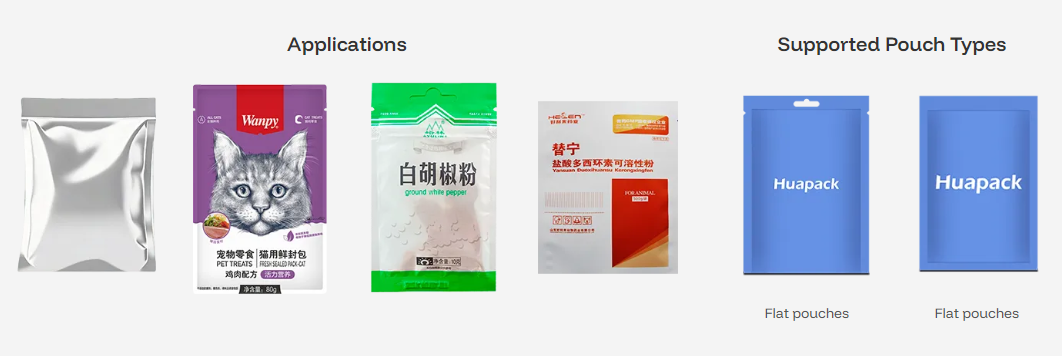
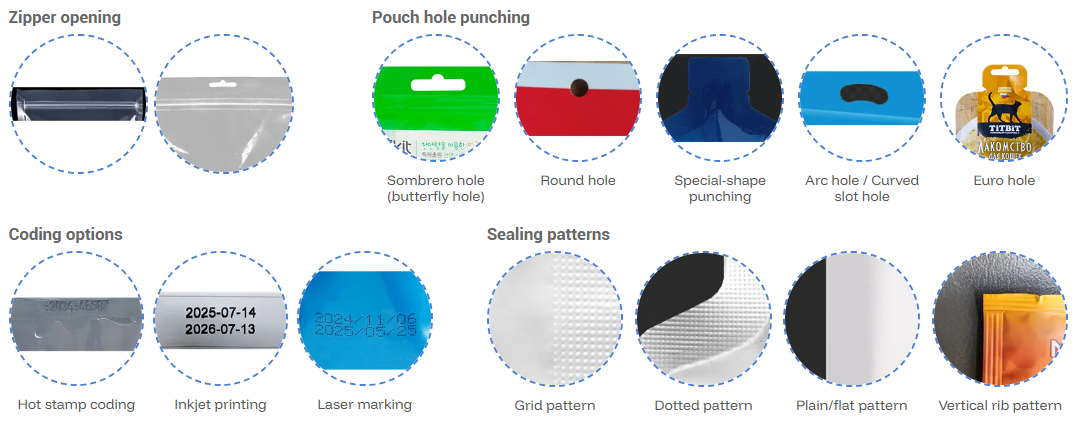
When I help a customer select a pouch packaging machine, I do not begin with speed or price. I first look at the product, pouch size, film material, filling range, sealing requirements, and the production target. These details tell me whether a machine will really fit the job.
Our Flat Pouch HFFS Packaging Machine, 1-Nozzle Filling – 130N/180N/240N is built for manufacturers that want to make and fill flat pouches automatically from roll film. I use one integrated process to form the pouch, fill the product, heat seal the package, and cut the finished pouch. There is no need to prepare pre-made empty bags for the forming stage.
At Shanghai Huacheng Packing Machinery Company (Huapack), we have focused on pouch packaging machinery since 2015. Based in Songjiang District, Shanghai, we integrate research and development, manufacturing, sales, and technical service in one operation. Our work covers pouch filling, automated weighing, sealing, multiple pouch formats, packaging-line integration, and turnkey packaging projects.
I designed this product page to explain how I look at the 130N, 180N, and 240N flat pouch HFFS packaging machine, what it can do, where it can be used, and what I would check before recommending a specific configuration.
1. What Is a Flat Pouch HFFS Packaging Machine?
HFFS means Horizontal Form Fill Seal. The idea is straightforward: the machine starts with a roll of flexible packaging film and turns it into finished pouches through a continuous automated process.
Instead of buying an empty pouch first, I feed the film directly into the machine. The machine forms the pouch, fills the product through one filling nozzle, seals the pouch with heat, and cuts it into an individual package.
This makes the machine particularly useful for manufacturers that need continuous packaging and want to combine pouch making and filling in one system.
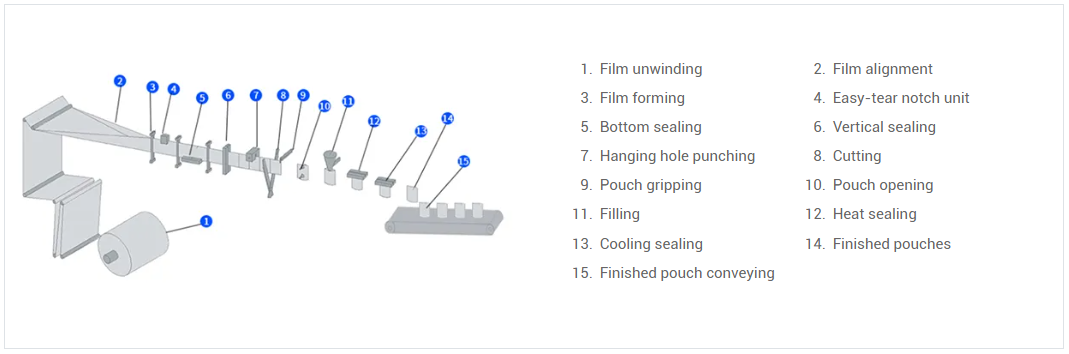
A typical process looks like this:
Roll film feeding
Film positioning and pouch forming
Product filling through one nozzle
Heat sealing
Color-mark tracking for printed film
Pouch cutting
Finished pouch discharge
The exact process and machine configuration depend on the product and pouch format. For example, a powder requires a different filling approach from a sauce, while a printed laminated film may require different handling from a simple PE film.
| Packaging Method | Basic Workflow | Packaging Material Approach | Typical Production Consideration |
|---|---|---|---|
| Pre-made pouch filling | Feed pouch → fill → seal | Uses purchased empty pouches | Requires storage and feeding of finished pouches |
| Flat pouch HFFS | Form → fill → seal → cut | Uses roll film | Combines pouch making and filling |
| Flat pouch HFFS with 1-nozzle filling | Form → single-nozzle fill → seal → cut | Uses roll film directly | Suitable where one filling point meets production requirements |
Source: Huapack product and process information supplied for this product page. Actual production performance depends on product characteristics, pouch dimensions, film structure, filling method, and machine configuration.
For buyers searching Google for an automatic flat pouch packaging machine, flat pouch HFFS machine, horizontal form fill seal packaging machine, or 1-nozzle pouch filling machine, this integrated structure offers a practical way to automate several packaging operations in one system.
2. How Our 1-Nozzle HFFS Machine Works
I prefer to explain the working principle from the point where the packaging material enters the machine. It makes the process much easier to understand.
Roll Film Feeding
The production process begins with a roll of flexible packaging film. Depending on the application, the machine can work with suitable PE film, laminated film, aluminum foil-based film, and other compatible flexible packaging materials.
The film moves through the machine in a controlled direction. Stable film movement matters because it affects pouch dimensions, printed artwork position, sealing, and cutting.
If the customer has already selected a film, I recommend checking the complete film structure instead of looking only at the material name. Two films may both be described as laminated film but have very different sealing layers and mechanical properties.
Pouch Forming
After entering the forming section, the film is shaped into the required flat pouch format. The final pouch size depends on the selected model, tooling, film width, and design requirements.
Before confirming a machine, I normally want to see the required pouch drawing or sample. This helps me understand the actual width, length, sealing position, and artwork requirements.
Single-Nozzle Filling
Once the pouch is ready for filling, the product is introduced through one filling nozzle.
A one-nozzle filling system can be a good choice when the product and target production capacity can be handled through a single filling point. It also keeps the filling structure relatively straightforward.
However, I never calculate real production output by nozzle count alone. Product density, viscosity, particle size, flow behavior, filling volume, filling accuracy, pouch dimensions, and machine cycle time can all affect production performance.
For example, a free-flowing granule may move quickly through a suitable filling system, while a sticky paste may require slower and more controlled filling. A fine powder may need special attention to dust and product contamination around the sealing area.
Heat Sealing
After filling, the pouch moves to the heat-sealing section. Controlled heat is applied to the suitable sealing layer of the film to create the required pouch seal.
Our machine uses an intelligent temperature control system to help maintain stable sealing conditions.
In real production, I always look at more than temperature. Film structure, sealing pressure, dwell time, film thickness, product contamination, and operating conditions can all influence the final seal.
Color-Mark Tracking
When the packaging film is printed, the color-mark tracking system can detect the registration mark on the film and help control the cutting position.
This is important for branded packaging. A logo, barcode, product name, or front graphic should not move randomly from one pouch to another.
Cutting and Discharge
After sealing, the machine cuts the connected pouch structure into individual packages. The finished pouches can then be transferred to an inspection system, conveyor, secondary packaging machine, or manual collection station.
The goal is simple: reduce unnecessary manual handling and keep the pouch production process continuous.
3. Main Features I Consider Important
When I evaluate a flat pouch HFFS packaging machine with single-nozzle filling, I focus on features that have a clear connection with daily production.
Integrated Forming, Filling, Sealing, and Cutting
The machine combines the main pouch-making operations into one automated workflow. The operator does not need to move empty pouches from a separate pouch-making process to the filling machine.
This integrated approach can simplify the production line and reduce manual pouch handling.
Roll-Film Packaging
Using roll film gives the manufacturer flexibility in choosing suitable packaging materials and printed film structures.
It can also help reduce the need to purchase and store pre-made empty pouches. The actual material cost advantage depends on film pricing, pouch design, production volume, and the customer's purchasing conditions, so I recommend making the comparison with real supplier quotations.
One-Nozzle Filling
The 1-nozzle configuration is designed for applications where one filling point is appropriate. It can be used with suitable filling systems for liquids, pastes, powders, granules, or other products depending on the machine configuration.
I always recommend product testing before making a final filling-system decision. The product itself determines whether the selected filling method will perform well.
Intelligent Temperature Control
Heat sealing needs stable conditions. The intelligent temperature control system helps the operator maintain the required sealing temperature during continuous operation.
A stable temperature does not automatically guarantee perfect sealing, though. The film and actual product also need to be suitable for the application.
Color-Mark Tracking
For printed film, registration marks help the machine identify the correct cutting position. This supports consistent package appearance and reduces the risk of graphics drifting away from the intended position.
Multiple Film Options
The machine can be configured for suitable PE film, composite or laminated film, and aluminum foil-based packaging film.
| Packaging Film | Potential Use | What I Check |
|---|---|---|
| PE Film | General flexible pouch applications | Forming behavior and sealing performance |
| Laminated Film | Food, nutrition, personal care, branded pouches | Film structure, barrier layer, sealing layer |
| Aluminum Foil-Based Film | Products requiring stronger barrier protection | Complete laminate structure and seal conditions |
Source: Huapack product information supplied for this page. Final film compatibility must be confirmed through actual application testing because film thickness, sealing layer, stiffness, and barrier properties vary by supplier and structure.
4. Where Can I Use This Flat Pouch Packaging Machine?
One reason I work with flat pouch systems is their wide range of possible applications. A small flat pouch can be used for everyday food products, cosmetic samples, pharmaceutical products, and even small industrial components.
Still, I distinguish between a possible application and a confirmed application. The product must be tested with the machine and packaging film before final production approval.
Food Packaging
Food is one of the major application areas for flat pouch packaging. Potential products include seasonings, snacks, sauces, instant food components, and dry ingredients.
For granular products, I look at flow characteristics and filling accuracy. For sauces and other pastes, viscosity becomes more important. For all food applications, sealing performance and suitable packaging materials need to be considered together.
Personal Care and Cosmetics
Flat pouches are suitable for many small-volume personal care applications. Potential examples include face mask products, skincare samples, wash-care samples, wet wipes, and similar products.
These products often place strong emphasis on package appearance. If the film is printed, accurate color-mark tracking becomes useful for keeping the graphics properly positioned.
Pharmaceutical and Medical Packaging
Selected pharmaceutical powders and suitable disposable medical products can be considered for flat pouch packaging.
For pharmaceutical and medical applications, I recommend reviewing the product, packaging material, sealing requirements, production environment, and applicable regulatory requirements in detail before selecting the machine.
Hardware and Electronics
Small hardware components, electronic parts, data cables, connectors, and accessories can also be individually packaged in flat pouches.
In these applications, the purpose of the pouch may be simple: keep small parts together, protect them during handling, and provide a clean surface for product information.
Chemical and Industrial Products
Suitable drying agents, granules, pastes, and other industrial consumables may also be packed using flat pouches.
Here, film compatibility becomes particularly important. I need to consider whether the product can affect the film, sealing layer, or package during storage.
| Industry | Example Products | Key Packaging Focus |
|---|---|---|
| Food | Snacks, seasonings, sauces, instant food components | Filling accuracy, sealing, package appearance |
| Personal Care | Skincare samples, wash-care products, wet wipes | Small pouch format, sealing, printed appearance |
| Pharmaceutical | Suitable powders and selected medical products | Product protection, sealing, applicable requirements |
| Hardware | Small parts and components | Individual packaging and handling |
| Electronics | Data cables and small accessories | Protection, identification, clean packaging |
| Industrial | Drying agents, granules, pastes | Material compatibility and seal integrity |
Source: Huapack application information supplied for this product page. Applications are examples only. Final suitability depends on the product, filling method, pouch format, packaging film, and production conditions.
5. 130N vs. 180N vs. 240N: How I Approach Model Selection
Customers often ask me which model they should buy. My answer is usually: do not choose the model from the name alone.
The 130N, 180N, and 240N models are different machine configurations within the same flat pouch HFFS packaging concept. The correct choice should be based on the actual pouch and production requirements.
| Selection Factor | Why It Matters | Information I Need |
|---|---|---|
| Pouch Dimensions | Determines whether the machine can form the required pouch | Pouch width, length, seal position, drawing |
| Filling Volume | Affects filling-system selection and cycle requirements | Target weight or volume per pouch |
| Product Characteristics | Different products flow differently | Powder, granule, liquid, paste, solid, etc. |
| Film Structure | Affects forming and heat sealing | Film material, thickness, laminate structure |
| Target Output | Determines the required production configuration | Required pouches per minute or per hour |
| Existing Line | Determines how the machine should connect to other equipment | Upstream and downstream equipment details |
Source: Huapack engineering and application methodology based on the product information supplied for this page. Final model selection requires confirmation of actual product, pouch, film, and production parameters.
For example, if a customer needs a small flat pouch with a relatively low filling volume, one model may be more appropriate than another. If the customer has a larger pouch or different film width requirement, a different configuration may be needed.
I also consider future production. A machine should not only satisfy today's output if the customer already knows that production will increase significantly in the near future. In that situation, I may recommend considering the future capacity and line layout before the machine is finalized.
6. How We Manufacture and Customize the Packaging Solution
At Huapack, our focus is not limited to selling a standard machine. We develop pouch packaging solutions around actual production requirements.
Since our establishment in 2015, we have integrated R&D, manufacturing, sales, and technical service within one operation. This allows us to connect engineering decisions with customer feedback and production needs.
When I work on a packaging project, I normally want to understand the full process rather than only the filling machine.
I look at:
The physical characteristics of the product
Required filling weight or volume
Pouch dimensions and shape
Packaging film type and structure
Sealing requirements
Required production capacity
Filling accuracy
Changeover requirements
Available factory space
Upstream and downstream equipment
This information helps us determine the appropriate machine configuration and whether additional equipment should be included.
For example, a food manufacturer may need an automated weighing system before the pouch filler. A powder application may need a dedicated powder filling system. A liquid or paste product may require a different pump and filling arrangement.
For customers that already have part of a production line, I can also look at how the HFFS machine should connect with the existing equipment.
Beyond standalone machines, Huapack can provide complete pouch packaging lines and turnkey packaging projects. These solutions can be developed around product characteristics, packaging format, production capacity, and factory layout.
Before final production, I recommend testing real product and film samples whenever possible. This allows us to evaluate the actual filling behavior, pouch forming, sealing, film tracking, cutting, and finished pouch quality.
7. Why I Choose Huapack for Pouch Packaging Projects
When I compare packaging machinery suppliers, I do not look only at the initial purchase price. A machine is a long-term production asset, so the supplier's technical understanding and support are equally important.
Huapack has a clear and dedicated focus on pouch packaging machinery. Our capabilities cover multiple pouch formats, automated weighing, pouch filling, sealing, and complete packaging-line integration.
We develop packaging solutions for food, dairy, health nutrition, medical nutrition, pharmaceuticals, personal care, agrochemicals, and pet food applications. This broad application experience helps us understand that different products require different machine configurations.
For a buyer searching for a flat pouch HFFS packaging machine manufacturer, we can provide more than the basic forming and sealing equipment. We can discuss the entire packaging process, from product feeding and weighing to pouch forming, filling, sealing, and final line integration.
For a customer searching specifically for a 1-nozzle flat pouch filling machine, we can evaluate whether the single-nozzle system is suitable for the product and target capacity.
I also pay close attention to technical support. Installation, commissioning, operator training, troubleshooting, spare parts, and communication after delivery can have a major effect on how quickly a new packaging machine becomes productive.
Our technical service is therefore part of the complete solution. The objective is not simply to deliver a machine, but to help customers build a stable, efficient, and scalable pouch packaging operation.
8. FAQ About the Flat Pouch HFFS Packaging Machine
What does HFFS stand for?
HFFS stands for Horizontal Form Fill Seal. The machine forms a pouch from roll film, fills the product, seals the package, and cuts the finished pouch automatically.
What does 1-nozzle filling mean?
It means the configured filling system uses one filling nozzle. This is suitable for applications where one filling point can meet the product and production requirements.
What products can be packed with this machine?
Potential applications include snacks, seasonings, sauces, dry food, powders, granules, personal care products, pharmaceutical powders, small hardware components, electronic accessories, drying agents, and suitable industrial products.
Can this machine package powder?
Suitable powder applications can be considered. The filling system must be selected according to powder density, flow characteristics, particle size, filling weight, dust behavior, and required accuracy.
Can I use the machine for liquid products?
Suitable liquid and paste products can be evaluated. The filling system should match the viscosity, flow behavior, filling volume, and other characteristics of the actual product.
Can it use printed film?
Yes. When suitable printed film is used, the color-mark tracking system can detect the registration mark and help control the cutting position.
What types of film can be used?
Suitable PE film, laminated film, and aluminum foil-based film can be considered. The final film structure should be confirmed through application evaluation because different structures have different forming and sealing properties.
What is the difference between the 130N, 180N, and 240N models?
The models represent different machine configurations for different pouch and production requirements. I recommend selecting the model after reviewing pouch dimensions, filling volume, product characteristics, film structure, and target output.
Can I change the pouch size?
Different pouch sizes can be produced within the applicable machine and tooling range. The exact range depends on the selected model, film width, pouch design, and machine configuration.
Can Huapack customize the machine?
Yes. We can develop functional customization and complete-line design according to product characteristics, pouch format, capacity requirements, and other production conditions.
Can this machine connect with other automatic equipment?
Yes. Huapack can integrate pouch packaging equipment with automated weighing, feeding, conveying, filling, sealing, and downstream packaging systems when required.
How can I confirm whether the machine is suitable for my product?
I recommend providing a product sample, film sample or film specification, target filling weight or volume, pouch dimensions, and expected production output. These details allow our engineering team to evaluate the application more accurately.
From Roll Film to a Finished Flat Pouch
For me, the biggest advantage of the Flat Pouch HFFS Packaging Machine, 1-Nozzle Filling – 130N/180N/240N is its simple and complete workflow.
I start with roll film instead of a pre-made empty pouch. The machine forms the package, fills the product through one nozzle, creates the heat seal, tracks the printed film when needed, and cuts the finished pouch.
This makes the equipment a practical option for manufacturers that want to automate flat pouch production while keeping the packaging process compact and organized.
But I do not believe that one machine configuration is right for every factory. The best solution depends on the product, pouch, film, filling volume, production target, and existing production line.
That is why our approach at Huapack starts with the application. Whether you are looking for an automatic flat pouch packaging machine, 1-nozzle HFFS filling machine, horizontal form fill seal packaging machine, or a complete pouch packaging line, we can develop the configuration around your actual production requirements.
If you are comparing the 130N, 180N, and 240N models, I recommend preparing your product information, pouch drawing, film specification, filling range, target output, and existing line details. With these details, our engineers can make a more practical recommendation instead of relying on assumptions.
Huapack focuses on pouch packaging machinery and complete packaging solutions, from individual HFFS machines to customized turnkey packaging lines.
Technical note: Machine configuration, pouch dimensions, filling capacity, production output, film compatibility, sealing conditions, and other technical parameters may vary according to the actual application. Final specifications should be confirmed with Huapack engineering after evaluation of the product, packaging film, pouch design, and production requirements.



 WhatsApp
 Phone
Phone E-mail